Buffalo Nickel
1936 Buffalo Nickel Errors, Varieties and Value
A year before the Denver Mint’s most famous Buffalo nickel error, a strikingly similar — but far rarer and less well-known — variety happened at the same mint: the 1936-D 3½ Legs. GetCoinHunt helps you search inventory from multiple coin dealers in one place, compare available examples, and create a wishlist alert when the right coin is not currently listed.
Design and history
The 1936 nickel carries James Earle Fraser’s Type 2 reverse, unchanged since midway through 1913: a composite Native American portrait on the obverse and a bison on a flatter, recessed reverse ground. All 1936 nickels are struck in 75% copper and 25% nickel, weigh 5.00 grams, measure 21.21mm, and have a plain edge. Philadelphia coins carry no mintmark; Denver and San Francisco pieces show a D or S beneath FIVE CENTS.
Errors and varieties to know
The rare 1936-D 3½ Legs (FS-901) resulted from excessive reverse-die polishing that removed much of the bison’s front foreleg — the same basic cause behind the more famous 1937-D Three-Legged Buffalo nickel struck at Denver the following year. PCGS reports an estimated fewer than forty surviving examples in its cited specialist estimate, making the 1936-D 3½ Legs a genuinely rare coin despite being far less widely known than its 1937-D counterpart. The two varieties are distinct dies and must each be matched to their own documented characteristics; a coin can’t be attributed as one simply because it resembles the other.
An abraded, worn, or intentionally tooled leg on an ordinary 1936-D nickel is not the variety. Genuine examples require inspection of the surrounding belly, ground, and specific die-polish characteristics documented by PCGS, not just a leg that appears thin or missing at a glance. Ordinary 1936, 1936-D, and 1936-S nickels are regular issues with no other major recognized variety.
How to examine a 1936 Buffalo nickel
- For a claimed 3½ Legs example, examine the front foreleg area under magnification and raking light, and compare the surrounding belly and ground detail against certified reference photos of FS-901 — the specific die-polish pattern must match, not just a thin-looking leg.
- Look for tool marks or an unnaturally sharp-edged depression where the leg should be, which points toward deliberate alteration of an ordinary coin rather than a genuine polished die.
- Genuine doubled dies show raised, rounded secondary design in a fixed, repeatable position; flat or shelf-like doubling is mechanical, not a collectible variety.
- Raised lines across the field typically indicate die cracks; incuse marks usually point to scratches or handling damage.
Given the strong premium attached to leg varieties in this series, deliberately altered coins are a well-documented risk — see our guide to documented counterfeit U.S. coins for background on how these alterations are typically detected. Never clean a candidate coin, and treat certification as essential for any claimed 3½ Legs example.
Buying considerations
Certified versus raw coins
Given its rarity and the well-documented practice of altering ordinary 1936-D nickels to fake a missing leg, buying a raw 3½ Legs coin at any meaningful price is genuinely risky. A PCGS- or NGC-certified example, with the certification number verified on the grading service’s website, is strongly recommended.
Understanding grades and condition
For ordinary 1936 nickels, wear follows the familiar pattern — the portrait’s cheekbone and hair braid first, then the bison’s shoulder and horn. Given how few 3½ Legs examples are known, grade has an outsized effect on price for that specific variety.
Problem coins
Cleaning, scratches, and environmental damage reduce value on any 1936 nickel, and on a claimed 3½ Legs example they can also make authentication more difficult. A details-graded example is still meaningful and collectible, but the stated problem should be clearly reflected in the price.
Suggested search terms and filters
Start broad: “1936 Buffalo nickel,” “1936-D 3½ Legs nickel,” “1936-D Buffalo nickel,” or “1936-S Buffalo nickel.”
Then narrow by:
- Issue: regular strike or 1936-D 3½ Legs (FS-901)
- Mint: no mark (Philadelphia), D (Denver), or S (San Francisco)
- Certification: PCGS, NGC, or raw
Availability and pricing notes
Ordinary 1936 nickels from all three mints are common and affordably priced. A certified 1936-D 3½ Legs is a genuinely rare coin whose price depends heavily on grade and documentation — compare against recent completed sales from a source such as Heritage Auctions or Stack’s Bowers rather than relying on any single listing.
GetCoinHunt does not guarantee that every listing is authentic, accurately graded, or fairly priced. Authentication, grading, pricing, return policies, and fulfillment remain the responsibility of the dealer or marketplace offering the coin.
How the GetCoinHunt wishlist alert works
- Search for the coin. Enter “1936 Buffalo Nickel” to search participating dealer inventory.
- Review the available matches. Compare listings by variety attribution, mint, grade, and certification.
- Add the search to your wishlist. If the right example isn’t available, save “1936 Buffalo Nickel” as a wishlist item with variety or grade preferences where available.
- Get notified about new matches. GetCoinHunt sends an alert when new dealer inventory matches your wishlist.
- Evaluate the coin before buying. Verify certification and photographs, read the full listing, and review the seller’s terms.
Frequently asked questions
What is the 1936-D 3½ Legs variety?
A Denver reverse die where excessive polishing removed much of the bison’s front foreleg. PCGS estimates fewer than forty examples survive, making it a genuinely rare, if lesser-known, variety.
How is it different from the 1937-D Three-Legged nickel?
Both resulted from similar over-polishing at the Denver Mint, but they’re distinct dies produced in different years. The 1937-D Three-Legged nickel is far more famous and more widely certified, while the 1936-D 3½ Legs is considerably rarer and less commonly encountered.
How can I tell a genuine 3½ Legs example from an altered coin?
Compare the surrounding belly and ground detail against certified reference photos of FS-901, and check for tool marks or an unnaturally sharp depression where the leg should be — signs of deliberate alteration rather than a genuine polished die.
Are ordinary 1936 nickels valuable?
No. All three mints struck common quantities, and typical examples trade at modest, affordable prices.
What if no suitable coin is currently available?
Add “1936 Buffalo Nickel” to your wishlist below. You’ll be notified when newly detected dealer inventory matches your search.
Illustrated diagnostic upgrades
The following marker cards consolidate CoinHunt’s researched variety diagnostics into this canonical guide. Each original vector is a diagnostic illustration, not a photograph, and its licensing record remains with the image asset.
1936 Buffalo Nickel Doubled Die Obverse FS-101
Documented Fact PCGS catalogs a Philadelphia 1936 Buffalo nickel doubled die obverse as FS-101. [1]
Quick Hunt
- Confirm the 1936 date and absence of a mintmark.
- Inspect the date and LIBERTY for raised, rounded secondary design contours.
- Compare the direction and spacing across several letters and digits with certified FS-101 images.
- Reject flat shelf-like machine doubling and random impact damage.
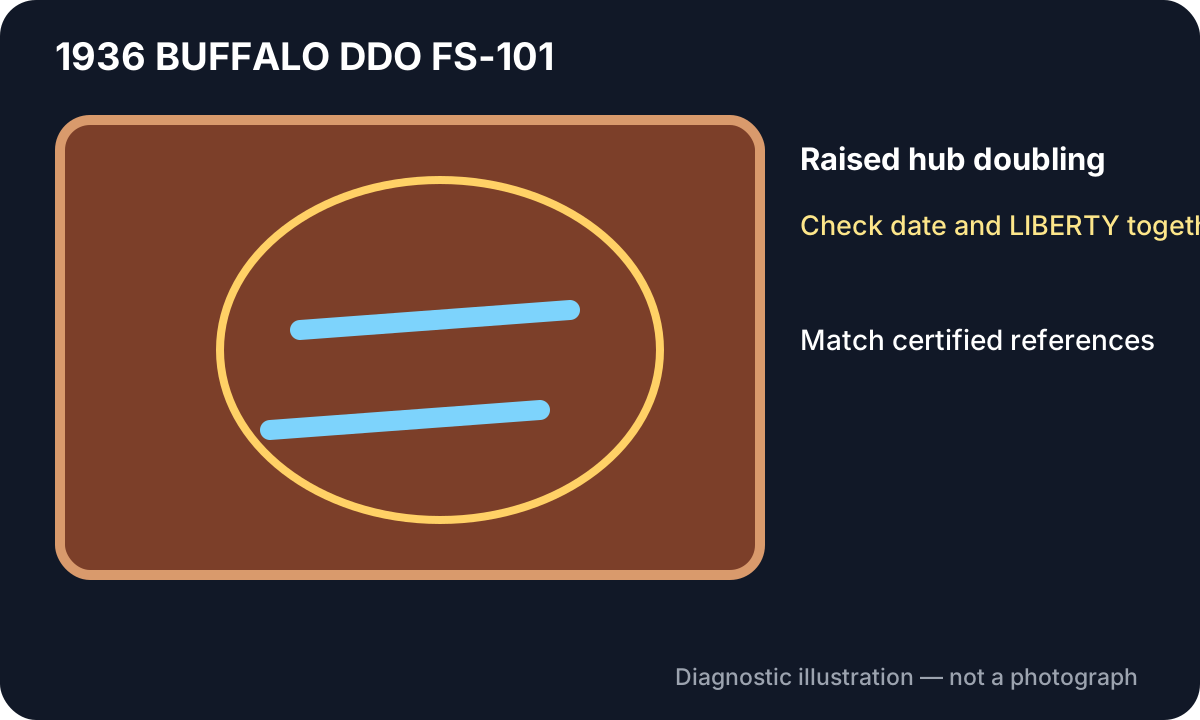
Diagnostic illustration — not a photograph.
Authentication Caution
One doubled-looking edge is not an attribution. Require multiple matching obverse markers and professional review for premium examples.
Image Credit
CoinHunt created this original vector inspection map because no exact reusable forensic photograph was approved.
Looking to buy or check current prices for this coin?Search it on CoinHunt →
Revision history
- : Integrated researched diagnostic illustrations, licensing metadata, attribution boundaries, and citations from duplicate variety pages. — Bradley Jones