Buffalo Nickel
1937 Buffalo Nickel Errors, Varieties and Value
Ask most collectors what they know about the 1937 Buffalo nickel and you’ll hear about one coin: the Three-Legged Denver variety. It deserves the attention, but it’s only one part of the year’s story — Philadelphia, an ordinary Denver strike, and San Francisco all issued normal nickels in 1937 that are worth understanding on their own terms. GetCoinHunt helps you search inventory from multiple coin dealers in one place, compare available examples, and create a wishlist alert when the right coin is not currently listed.
Design and history
The 1937 nickel carries James Earle Fraser’s Type 2 reverse, unchanged since midway through 1913: a composite Native American portrait on the obverse and a bison on a flatter, recessed reverse ground. All 1937 nickels are struck in 75% copper and 25% nickel, weigh 5.00 grams, measure 21.21mm, and have a plain edge. Philadelphia coins carry no mintmark; Denver and San Francisco pieces show a D or S beneath FIVE CENTS. This was the series’ second-to-last year, with the Jefferson nickel taking over the following year, as covered on our 1938 page.
Errors and varieties to know
If you’re looking for the famous 1937-D Three-Legged Buffalo nickel, created when aggressive die polishing at the Denver Mint removed the bison’s front foreleg, see our dedicated guide to the 1937-D Three-Legged Buffalo nickel for identification details, diagnostics, and buying guidance specific to that variety. This page focuses on everything else about the 1937 date.
Beyond the Three-Legged coin, no other major, broadly recognized error or die variety is singled out for 1937 in the principal PCGS and NGC references. The overwhelming majority of 1937-D nickels are ordinary four-legged coins from a different, unaffected die — the Three-Legged variety came from a single reworked die, not the entire Denver mintage for the year. Philadelphia and San Francisco issues from 1937 are both regular coins with no attributed variety of their own.
How to examine a 1937 Buffalo nickel
- If you’re checking a 1937-D nickel specifically to rule in or out the Three-Legged variety, refer to our dedicated guide for the specific diagnostics, including the rear-leg weakness that PCGS graders use to help confirm genuine examples.
- For ordinary Philadelphia, Denver, and San Francisco 1937 nickels, check general strike quality on the bison’s horn and shoulder, since a sharp strike is a legitimate reason for a premium even on a common issue.
- Genuine doubled dies show raised, rounded secondary design in a fixed, repeatable position; flat or shelf-like doubling is mechanical, not a collectible variety.
- Raised lines across the field typically indicate die cracks; incuse marks usually point to scratches or handling damage.
As with other dates in this series, worn or damaged dates are sometimes chemically treated or re-engraved to appear sharper — a practice covered in our guide to documented counterfeit U.S. coins. Avoid cleaning any candidate coin before it’s been evaluated.
Buying considerations
Certified versus raw coins
A raw ordinary 1937 nickel from any of the three mints is a reasonable purchase at common grades. If you’re shopping for the Three-Legged variety specifically, certification is close to essential given how frequently that coin is faked — see the dedicated guide linked above for details.
Understanding grades and condition
Wear on ordinary 1937 nickels follows the familiar pattern — the portrait’s cheekbone and hair braid first, then the bison’s shoulder and horn. All three mints struck substantial quantities this year, and Mint State examples are relatively available compared to earlier dates in the series.
Problem coins
Cleaning, corrosion, and environmental damage are common among circulated coins from this era. A details-graded ordinary 1937 nickel is a sensible, low-cost way to fill the date, provided the price reflects the stated problem.
Suggested search terms and filters
Start broad: “1937 Buffalo nickel,” “1937-D Buffalo nickel,” “1937-S Buffalo nickel,” or “1937 Philadelphia nickel.” If you’re after the famous leg variety specifically, search “1937-D Three-Legged nickel” instead.
Then narrow by:
- Mint: no mark (Philadelphia), D (Denver), or S (San Francisco)
- Issue: ordinary strike or the separately listed Three-Legged variety
- Certification: PCGS, NGC, or raw
Availability and pricing notes
Ordinary 1937 nickels from all three mints are common and affordably priced. The Three-Legged variety trades in an entirely different price range, covered in detail on its own page. Compare recent completed sales before assuming any listing’s asking price reflects the market.
GetCoinHunt does not guarantee that every listing is authentic, accurately graded, or fairly priced. Authentication, grading, pricing, return policies, and fulfillment remain the responsibility of the dealer or marketplace offering the coin.
How the GetCoinHunt wishlist alert works
- Search for the coin. Enter “1937 Buffalo Nickel” — or “1937-D Three-Legged Buffalo Nickel” for the famous variety — to search participating dealer inventory.
- Review the available matches. Compare listings by mint, issue, grade, and certification.
- Add the search to your wishlist. If the right example isn’t available, save your preferred search as a wishlist item with mint or grade preferences where available.
- Get notified about new matches. GetCoinHunt sends an alert when new dealer inventory matches your wishlist.
- Evaluate the coin before buying. Verify certification and photographs, read the full listing, and review the seller’s terms.
Frequently asked questions
Is every 1937-D nickel the Three-Legged variety?
No. The Three-Legged variety came from a single reworked Denver die, and the vast majority of 1937-D nickels are ordinary four-legged coins with no special attribution.
Where can I learn more about the Three-Legged variety specifically?
See our dedicated guide to the 1937-D Three-Legged Buffalo nickel for identification diagnostics, grading, and buying guidance.
Is there another major variety for 1937 besides the Three-Legged coin?
No. Beyond the Three-Legged Denver coin, no other major, broadly recognized error or die variety is documented for 1937 in the principal references used here.
Are Philadelphia and San Francisco 1937 nickels scarce?
Both are regular issues struck in substantial quantities and are common at typical grades, with price driven mainly by grade and strike rather than mint scarcity.
What if no suitable coin is currently available?
Add “1937 Buffalo Nickel” to your wishlist below. You’ll be notified when newly detected dealer inventory matches your search.
Illustrated diagnostic upgrades
The following marker cards consolidate CoinHunt’s researched variety diagnostics into this canonical guide. Each original vector is a diagnostic illustration, not a photograph, and its licensing record remains with the image asset.
1937-D Three-Legged Buffalo Nickel
Documented Fact Excessive polishing of a Denver reverse die removed most of the bison’s forward-facing foreleg while leaving its hoof. Genuine examples also carry repeatable die markers; a missing leg by itself is not enough because ordinary 1937-D nickels are frequently altered. [1] [2]
Quick Hunt
- Confirm 1937 on the obverse and a D mintmark beneath FIVE CENTS on the reverse.
- Check that most of the bison’s front-right foreleg is absent but the hoof remains.
- Look for the thin raised arc running down-left from between the hind legs—the traditional “stream” marker.
- Inspect the back of the Indigenous portrait’s neck for the rough, eroded “moth-eaten” die texture.
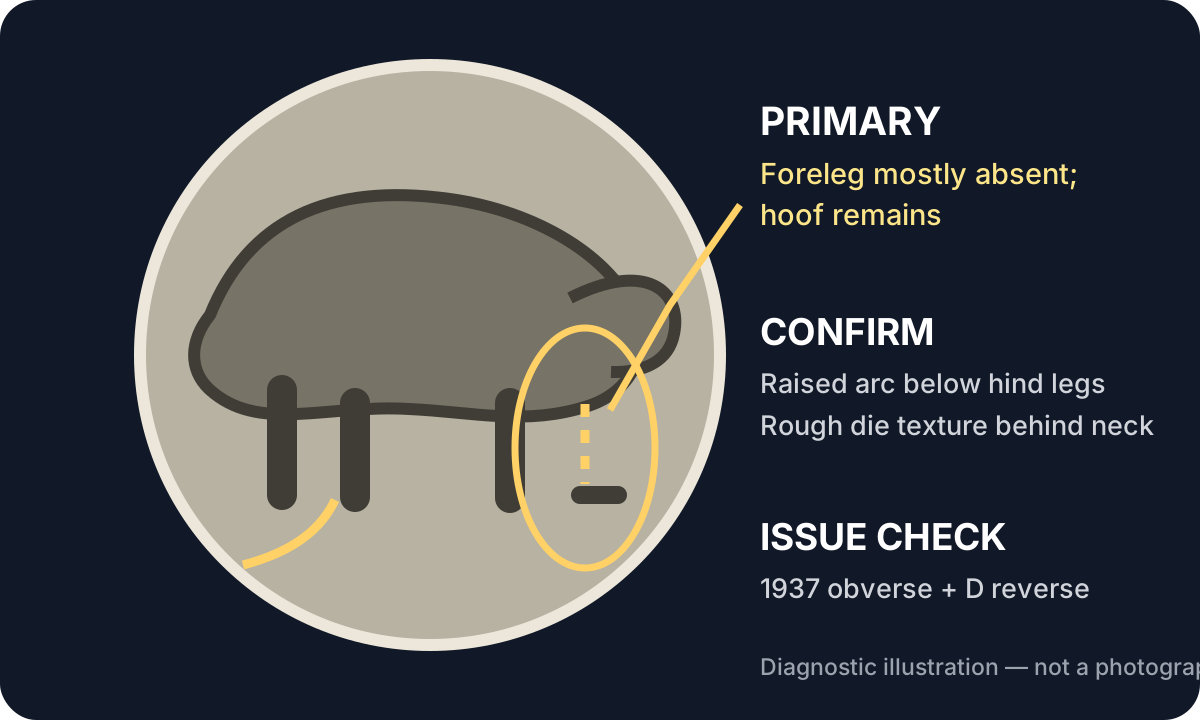
Diagnostic illustration — not a photograph.
Primary Marker — Missing Foreleg
The die-polished leg is the bison’s front-right leg as seen on the coin. Most of the leg disappears into the field, but the hoof remains. The rear leg may also look weak and rough. Do not accept a sharp-edged ground-away patch as a mint-made feature.
Anti-Counterfeit Markers
NGC documents a genuine raised arc descending leftward from the hind-leg area. Genuine dies also show heavy erosion behind the portrait’s neck on the obverse. These independent markers matter because counterfeiters can remove a leg from a normal 1937-D nickel but cannot easily reproduce the correct linked die state. [2] [3]
What It Is Not
- Altered normal coin: tooling removes the leg after striking and may leave scratches or unnatural smoothing.
- Weak strike: reduced detail without the full recognized die-marker combination.
- Damage or wear: loss of relief that also affects neighboring design elements inconsistently.
Authentication Caution
This variety is heavily counterfeited. Do not clean or tool the surface. Any purchase or sale at a substantial premium should rely on professional authentication, not a photograph or this screening diagram alone.
Image Credit
No exact forensic photograph with sufficiently clear reusable licensing was approved. CoinHunt created this original vector marker map from the cited facts. It does not represent grade, color, surface texture, or die stage.
Looking to buy or check current prices for this coin?Search it on CoinHunt →
Revision history
- : Integrated researched diagnostic illustrations, licensing metadata, attribution boundaries, and citations from duplicate variety pages. — Bradley Jones