Washington Quarter
1937 Washington Quarter Errors and Varieties: Identification Guide
The 1937 Washington quarter carries a genuinely recognized doubled-die obverse from the Philadelphia mint. GetCoinHunt helps you search inventory from multiple coin dealers in one place, compare available examples, and create a wishlist alert when the right coin is not currently listed.
Design and history
The 1937 Washington quarter belongs to John Flanagan’s long-running eagle-reverse design type, struck to mark the bicentennial of George Washington’s birth. The obverse shows Washington after Jean-Antoine Houdon’s portrait bust; the reverse depicts a perched eagle with wings spread above a bundle of arrows and an olive branch. This design ran from 1932 through 1998, aside from the dual-dated 1776–1976 Bicentennial quarter, before giving way to the 50 State Quarters Program in 1999, per the U.S. Mint’s quarter history.
1937 quarters were struck at Philadelphia, Denver, and San Francisco in the series’ standard composition of 90% silver and 10% copper, nominally 6.25 grams.
Preserve original surfaces when examining any coin from this era — never clean or polish a quarter to make a suspected feature easier to see. Cleaning creates hairlines and can destroy both collector value and diagnostic evidence.
Errors and varieties to know
The 1937 Philadelphia doubled-die obverse is a major recognized variety, according to NGC’s VarietyPlus and PCGS CoinFacts. Look for strong, rounded doubling in the date and obverse lettering; flat, shelf-like spread is machine doubling, not the recognized die variety.
A doubled die occurs when a working die receives more than one misaligned impression from the hub during manufacture, causing design elements to appear doubled on every coin struck from it. This is different from machine (strike) doubling, which happens at the moment of striking on an individual coin and produces a flatter, less defined secondary image.
How to examine a 1937 Washington quarter
Concentrate on the date numerals and obverse lettering, comparing them against certified reference images of the recognized doubled-die obverse.
Use a 5x to 10x loupe under diffuse, raking light:
- Genuine doubled-die doubling is raised, rounded, and repeats on every coin struck from that die.
- Machine doubling looks flat and shelf-like, without true separation between the primary and secondary images.
- Incuse cuts, displaced metal, bright scrapes, flattened rims, and random dents point toward post-mint damage, not a die feature.
If the coin appears off-metal, weigh it on a scale accurate to 0.01 gram; a normal 90% silver quarter from this era weighs about 6.25 grams. Photograph the whole obverse, whole reverse, edge, and the doubling under neutral light before seeking attribution.
Buying considerations
Certified versus raw coins
Because machine doubling is often mistaken for a genuine doubled die, a certified example from PCGS or NGC that explicitly attributes the coin as a doubled-die obverse is strongly recommended. Verify the certification number on the grading service’s own website.
Understanding grades and condition
Ordinary 1937 quarters without the doubled die are common in circulated grades. The confirmed doubled-die obverse carries a real premium that rises with grade. Compare strike quality, luster, and marks, and confirm that any variety attribution is backed by a recognized grading service.
Problem coins
Watch for listings describing cleaned, scratched, bent, or corroded coins. Cleaning can blur the fine detail needed to confirm genuine doubling, making attribution harder and reducing value.
Suggested search terms and filters
Begin with a broad search: “1937 Washington quarter,” “1937 doubled die quarter,” “1937-P Washington quarter,” “1937-D Washington quarter,” or “1937-S Washington quarter.”
Then narrow with:
- By mint mark: P, D, or S
- By variety: “1937 doubled die obverse”
- By grade: circulated grades through Mint State
- By certification: PCGS, NGC, or “certified 1937 DDO”
Availability and pricing notes
Ordinary 1937 quarters are common and inexpensive across all three mints. The confirmed doubled-die obverse carries a real premium over an ordinary example, rising further in higher grades. Listings and asking prices don’t necessarily represent completed-sale values, so compare the specific variety attribution, grade, and certification carefully before buying.
GetCoinHunt does not guarantee that every listing is authentic, accurately graded, or fairly priced. Authentication, grading, pricing, return policies, and fulfillment remain the responsibility of the dealer or marketplace offering the coin.
How the GetCoinHunt wishlist alert works
- Search for the coin. Enter “1937 Washington Quarter Doubled Die” to search participating dealer inventory.
- Review the available matches. Compare listings by variety attribution, grade, certification, and asking price.
- Add the search to your wishlist. If the right example isn’t available, save it as a wishlist item.
- Get notified about new matches. GetCoinHunt sends an alert when new dealer inventory matches your wishlist.
- Evaluate the coin before buying. Verify certification and photographs before purchasing.
Frequently asked questions
What is the 1937 doubled-die obverse quarter?
A recognized Philadelphia doubled die showing strong, rounded doubling in the date and obverse lettering, caused by a misaligned hubbing during die manufacture.
How do I tell it apart from machine doubling?
Genuine doubled-die doubling is raised, rounded, and repeats on every coin from the same die. Machine doubling looks flat and shelf-like and doesn’t carry the same premium.
Is an ordinary 1937 quarter valuable?
No. Ordinary examples without the doubled die are common and inexpensive. Value concentrates in the confirmed doubled-die variety and in high Mint State grades.
What if no suitable coin is currently available?
Add “1937 Washington Quarter Doubled Die” to your wishlist below. You’ll be notified when newly detected dealer inventory matches your search.
Illustrated diagnostic upgrades
The following marker cards consolidate CoinHunt’s researched variety diagnostics into this canonical guide. Each original vector is a diagnostic illustration, not a photograph, and its licensing record remains with the image asset.
1937 Washington Quarter Doubled Die Obverse FS-101
Documented Fact FS-101 is the major 1937 Philadelphia Washington quarter doubled die obverse. The clearest documented doubling appears in IN GOD WE TRUST and the date. [1] [2]
Quick Hunt
- Confirm a 1937 quarter with no mintmark.
- Inspect IN GOD WE TRUST for separated, rounded secondary letter edges.
- Check the date for matching clockwise hub doubling.
- Require the same spread across multiple devices; reject flat shelf-like machine doubling.
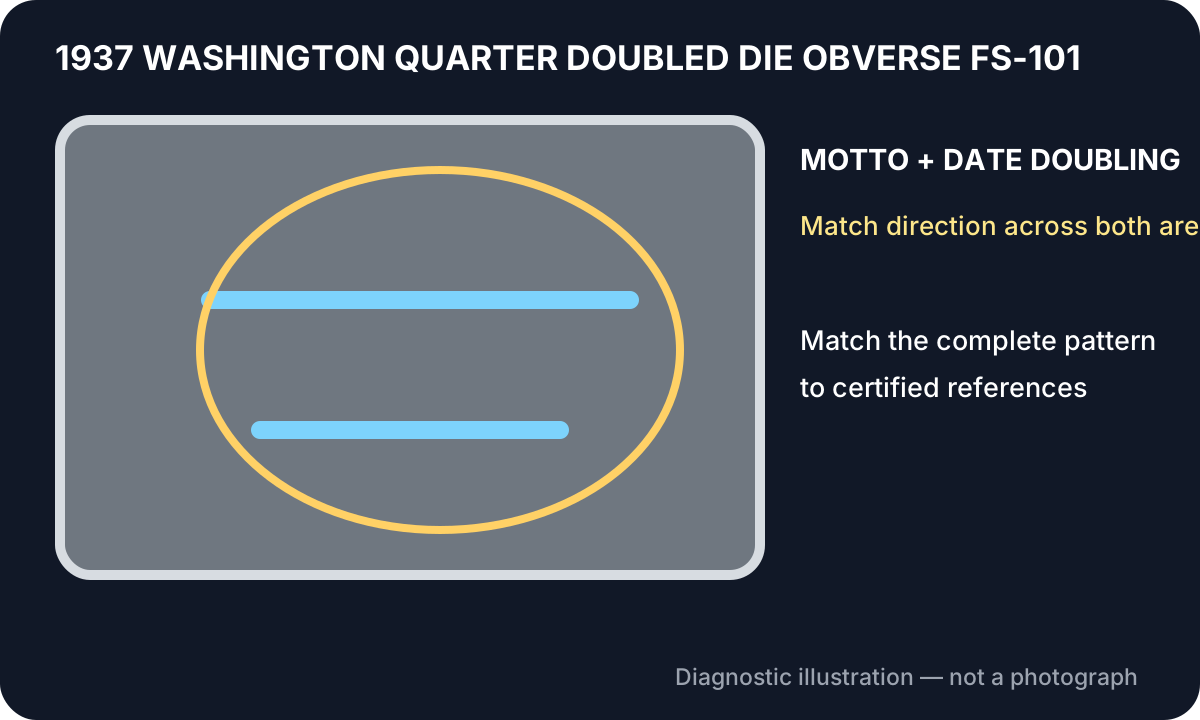
Diagnostic illustration — not a photograph.
Primary Diagnostic
The motto and date must agree. Genuine hub doubling is part of the die and preserves rounded design contours; it is not a flat reduction of the letters.
What It Is Not
Machine doubling, strike doubling, or circulation damage may affect one edge but will not reproduce the certified FS-101 direction and spacing.
Authentication Caution
Use stable magnification and several lighting angles. Match the complete marker relationship to certified examples, do not clean the coin, and obtain professional attribution before paying a substantial premium.
Image Credit
No exact forensic photograph with sufficiently clear reusable licensing was approved. CoinHunt created this original vector marker map from the cited facts. It explains marker relationships and does not represent grade, color, surface texture, or die stage.
Looking to buy or check current prices for this coin?Search it on CoinHunt →
Revision history
- : Integrated researched diagnostic illustrations, licensing metadata, attribution boundaries, and citations from duplicate variety pages. — Bradley Jones