Jefferson Nickel
1942 Jefferson Nickel Errors, Key Dates and Varieties
The 1942 Jefferson nickel carries Felix Schlag’s familiar Jefferson-and-Monticello design into another year of a series collectors build by date and mint. GetCoinHunt helps you search inventory from multiple coin dealers in one place, compare available examples, and create a wishlist alert when the right coin is not currently listed.
Design and history
The 1942 Jefferson nickel uses Felix Schlag’s portrait of Thomas Jefferson on the obverse and his Monticello reverse. Standard diameter is 21.21 mm and the edge is plain. Composition for this year is split: early pieces are 75% copper and 25% nickel, while the later wartime pieces are 35% silver, 56% copper, and 9% manganese, still 5.00 grams. Two compositions occur within the year. Early Philadelphia and Denver nickels used the standard 75% copper, 25% nickel alloy. Later in the year, Philadelphia and San Francisco switched to the wartime 35% silver, 56% copper, 9% manganese alloy and began carrying a large mintmark above Monticello — the first time a P mintmark appeared on a U.S. coin. PCGS CoinFacts catalogs the full run of dates and mints for the design.
Errors and varieties to know
The headline issue for 1942 is the mid-year switch to the wartime silver alloy.
The defining 1942 story is composition, not a die variety. Early Philadelphia and Denver nickels used the standard 75% copper, 25% nickel alloy. Later in the year, Philadelphia and San Francisco switched to the wartime 35% silver, 56% copper, 9% manganese alloy and began carrying a large mintmark above Monticello — the first time a P mintmark appeared on a U.S. coin. Never identify silver content by color alone; weigh and, where possible, test the coin.
Establish the strike type, mint, and composition before studying a small feature. A genuine doubled die, overdate, or overmintmark repeats on every coin struck from the affected die and must match the position, shape, and spread documented in a reputable attribution. Raised, rounded secondary detail belongs to the die; an incuse cut generally reflects damage. Mechanical (strike) doubling is normally flat and shelf-like, while die deterioration makes devices look swollen or ragged rather than crisply doubled.
How to examine a 1942 Jefferson nickel
For a wartime silver nickel, the large mintmark above Monticello and the coin’s weight are the first screens — a genuine wartime piece should weigh close to 5.00 grams and carry the enlarged mintmark. Color alone is unreliable, since silver-alloy nickels can tone dark and an ordinary copper-nickel piece can be plated to imitate one. Use nondestructive testing (weight, and specific-gravity or XRF testing where available) and seek professional authentication before treating any apparent wrong-alloy or wrong-planchet coin as genuine.
A genuine off-center strike should omit part of the design and show an unstruck crescent. A clipped planchet should show compatible rim and edge characteristics. Broadstrikes expand beyond the normal diameter, and strike-throughs leave a depression or transferred texture rather than added metal. Vise jobs, dryer damage, acid exposure, and altered mintmarks all happen after the coin leaves the press — they are post-mint damage, not Mint errors.
Photograph the whole obverse, whole reverse, and edge in the same lighting before comparing a suspected feature with a normal example. Never clean, polish, or dip a candidate coin — cleaning creates hairlines and can destroy both collector value and diagnostic evidence.
Buying considerations
Certified versus raw coins
A certified coin has been authenticated, graded, and sealed in a holder by a third-party grading service such as PCGS or NGC. A raw coin is sold without that certification.
Before purchasing a certified coin:
- Confirm that the holder is from a recognized grading service.
- Verify the certification number through the grading service’s official website.
- Compare the holder’s photographs, when available, with the coin being offered.
- Remember that counterfeit grading holders also exist.
Understanding grades and condition
Full Steps refers to clear, uninterrupted steps at the base of Monticello on qualifying Mint State coins. It is a strike-quality designation recognized by the grading services, not an error or a separate variety, and it can add a meaningful premium to an otherwise common date. Value depends on the exact date, mint, recognized attribution, grade, and surface originality — compare completed sales rather than asking prices, and use third-party authentication for high-value keys and major varieties.
Problem coins
Watch for listings that describe cleaned, improperly cleaned, scratched, bent, damaged, corroded, environmental damage, or altered surfaces. Problem coins are sometimes placed in holders with a details grade rather than a standard numerical grade — they can be a less expensive way to own the coin, but you should understand the stated problem and compare the asking price accordingly.
Suggested search terms and filters
Begin with a broad search: “1942 Jefferson nickel,” “1942-P Jefferson nickel,” or “1942-D Jefferson nickel.”
Then narrow the results with terms that reflect your collecting goal:
- By mint mark: P or S wartime, or P/D standard-alloy
- By grade: circulated, MS60-MS67 and above
- By certification: PCGS, NGC, or “certified 1942 Jefferson nickel”
- By feature: the mid-year switch to the wartime silver alloy (described with the exact attribution, not marketed as a guess)
Availability and pricing notes
Coin availability can change quickly. Listings and asking prices do not necessarily represent completed-sale values — compare multiple examples, consider each coin’s grade and surface quality, and review recent market information before purchasing. Because this year’s nickels contain 35% silver, their floor value tracks the price of silver in addition to any numismatic premium — factor current bullion value into any asking price you compare.
GetCoinHunt does not guarantee that every listing is authentic, accurately graded, or fairly priced. Authentication, grading, pricing, return policies, and fulfillment remain the responsibility of the dealer or marketplace offering the coin.
How the GetCoinHunt wishlist alert works
- Search for the coin. Enter “1942 Wartime Nickel” to search participating dealer inventory.
- Review the available matches. Compare listings by grade, certification, condition, dealer, and asking price.
- Add the search to your wishlist. If the right example is not available, save “1942 Wartime Nickel” as a wishlist item. Add grade, grading-service, or price preferences when those options are available.
- Get notified about new matches. When new dealer inventory matches your wishlist, GetCoinHunt sends an alert so you can review the listing before it disappears.
- Evaluate the coin before buying. Open the dealer’s listing, verify the certification and photographs, read the complete description, and review the seller’s terms.
Frequently asked questions
How do I tell a wartime 1942 nickel from a standard one?
Look for the large mintmark above Monticello, which the Mint added specifically to flag the wartime silver alloy. Weigh the coin — genuine wartime pieces are close to 5.00 grams — and don’t rely on color, since toning and plating can both mislead.
How do I tell a die variety from a mint error or damage?
A die variety repeats on every coin struck from the same die and shows raised, rounded, repeatable detail. A mint error is an individual manufacturing accident, such as an off-center strike or a wrong planchet. Post-mint damage happens after the coin leaves the Mint and is not a genuine feature.
Is a 1942 Jefferson nickel worth much?
Ordinary circulated examples are common and inexpensive. Value concentrates in high-grade Mint State coins, confirmed examples of the mid-year switch to the wartime silver alloy, and certified pieces with a verified attribution.
What if no suitable coin is currently available?
Add “1942 Wartime Nickel” to your wishlist below. You’ll be notified when newly detected dealer inventory matches your search.
Illustrated diagnostic upgrades
The following marker cards consolidate CoinHunt’s researched variety diagnostics into this canonical guide. Each original vector is a diagnostic illustration, not a photograph, and its licensing record remains with the image asset.
1942-D/D Horizontal D Jefferson Nickel FS-501
Documented Fact The working die first received a D mintmark in the wrong orientation, then an upright D was punched over it. [1] [2]
Quick Hunt
- Confirm a 1942 nickel with the small D to the right of Monticello; this is not a wartime large-mintmark reverse.
- Inspect the D for raised remnants aligned horizontally beneath the final upright punch.
- Match all remnants to certified FS-501 references.
- Reject ordinary D/D repunching, damage, and machine doubling.
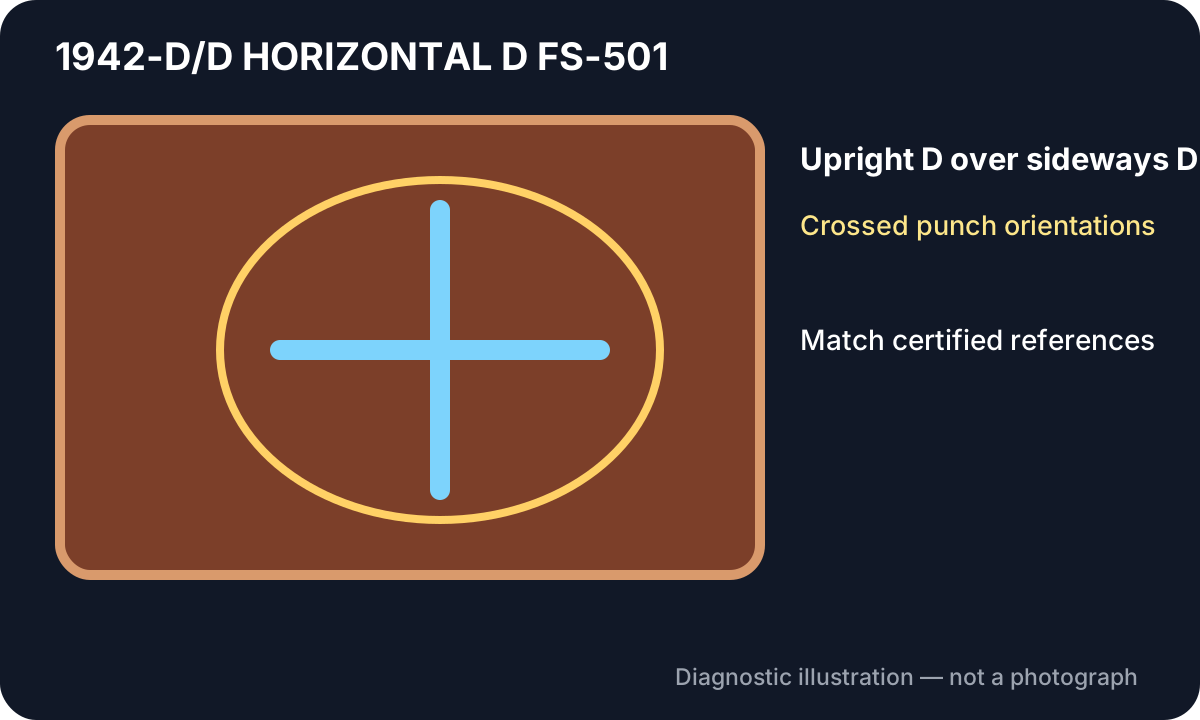
Diagnostic illustration — not a photograph.
Image Credit
CoinHunt created this original vector marker map because no exact reusable forensic photograph was approved.
Looking to buy or check current prices for this coin?Search it on CoinHunt →
Revision history
- : Integrated researched diagnostic illustrations, licensing metadata, attribution boundaries, and citations from duplicate variety pages. — Bradley Jones