Mercury Dime
1942 Mercury Dime Errors, Key Dates, Varieties and Value
The 1942 Mercury dime was struck at Philadelphia, Denver and San Francisco, and this year produced the series’ two most celebrated die varieties: the 1942/1 overdate at Philadelphia and the 1942/1-D overdate at Denver. GetCoinHunt helps you search inventory from multiple coin dealers in one place, compare available examples, and create a wishlist alert when the right coin is not currently listed.
Design and history
The 1942 Winged Liberty Head dime – the coin’s official name, though collectors commonly call it the “Mercury” dime because Liberty’s winged cap was mistaken for the Roman god – was struck at Philadelphia, Denver and San Francisco. Adolph A. Weinman designed both sides: the obverse depicts Liberty wearing a winged Phrygian cap, intended to symbolize freedom of thought, and the reverse combines a fasces, representing unity and authority, with an olive branch for peace. Weinman’s monogram appears on the obverse; D and S mint marks, when present, appear on the reverse near the lower-left portion of the fasces, while Philadelphia coins carry no mint mark. Philadelphia also produced proof Mercury dimes in 1942; a proof is an intentional collector strike, not an error, and should be judged by proof diagnostics and provenance rather than shine alone.
The series is 90% silver and 10% copper throughout, with a standard weight of 2.50 grams, a diameter of 17.90 mm, and a reeded edge, per PCGS CoinFacts.
Errors and varieties to know
1942 contains the series’ two most celebrated die varieties: the 1942/1 overdate at Philadelphia and the 1942/1-D overdate at Denver. Both came from dies that still show remnants of a 1 beneath the final 2 in the date. On the Philadelphia coin, look for clear underdigit traces around the 2 and the other date characteristics documented for that die. The Denver overdate has its own separate diagnostic remnants and must not be judged against the Philadelphia pattern – the two are different dies with different evidence. Ordinary die wear, a hit across the 2, or a reflection in a photograph is not an overdate. Both varieties are scarce and should be authenticated by a major grading service before you pay an overdate premium.
See PCGS’s dedicated write-up on the 1942/1 Mercury dimes for the full diagnostic detail.
How to examine a 1942 Mercury dime
Begin with the date and mint mark under one steady, directional light, then rotate the coin beneath it. Compare both sides with a problem-free example of the same date and mint:
- A genuine punched or repunched element is raised and belongs to the die; a scratch is incuse and may push metal along its edge.
- True doubled-die or overdate detail is rounded and repeats in the exact locations documented for that die; mechanical doubling is flat and shelf-like.
- Die deterioration creates swelling or erosion, not a clean second digit.
- A true off-center strike omits part of the design and leaves an unstruck crescent; a clipped planchet shows compatible rim and edge effects; a broadstrike expands outside the collar; strike-throughs leave smooth depressions or transferred texture.
For mint marks, examine the surrounding field for seams, depressions, discoloration, or tooling – these can expose an added or moved mint mark. Surface continuity matters most on valuable dates. A genuine coin can still be harshly cleaned, scratched, or repaired, which reduces value even when the date and mint mark are authentic.
Bent, squeezed, plated, acid-treated, or dryer-damaged coins are altered after striking and are not Mint errors. If the coin appears off-metal, record its weight on a scale accurate to 0.01 gram alongside diameter, thickness, edge color, and orientation, and compare against the standard 2.50-gram, 17.90 mm, reeded-edge specification. For a valuable-looking discovery, seek attribution from a specialist or certification from a major grading service before treating any price claim as reliable.
Buying considerations
Certified versus raw coins
A certified coin has been authenticated, graded, and sealed in a holder by a third-party grading service such as PCGS or NGC. A raw coin is sold without that certification.
Before purchasing a certified coin:
- Confirm that the holder is from a recognized grading service.
- Verify the certification number through the grading service’s official website.
- Compare the holder’s photographs, when available, with the coin being offered.
- Remember that counterfeit grading holders also exist.
For a claimed 1942/1 or 1942/1-D overdate, third-party authentication is essential – these are among the most valuable and most counterfeited varieties in the entire series, and an unattributed “overdate” claim should not be taken at face value.
Understanding grades and condition
Wear on a Mercury dime first appears in Liberty’s hair and on the high central reverse. “Full Bands” describes complete separation in the horizontal bands around the center of the fasces on qualifying Mint State coins – it is a strike-quality designation, not a die variety or an error, and NGC’s grading discussion explains it in more detail. A Full Bands premium can be substantial for dates that are normally weakly struck, but the coin must also be uncirculated and meet the grading service’s specific definition.
When comparing listings, look at:
- How clearly the date, mint mark, and design details are struck
- Remaining luster on uncirculated examples
- Marks, scratches, rim damage, or discoloration
- Whether the assigned grade – and any Full Bands designation – is supported by a recognized grading service
Do not estimate value from a dramatic asking price. Match the precise date, mint, attribution, and grade to completed auction results before assuming a listing reflects fair market value.
Problem coins
Watch for listings that describe cleaned, improperly cleaned, scratched, bent, damaged, corroded, environmental damage, or altered surfaces. Problem coins are sometimes placed in holders with a details grade rather than a standard numerical grade – they can be a less expensive way to own the date, but you should understand the stated problem and compare the asking price accordingly.
Suggested search terms and filters
Begin with a broad search: “1942 Mercury dime,” “1942-D Mercury dime,” or “1942-S Mercury dime.”
Then narrow the results with terms that reflect your collecting goal:
- By mint mark: no mark (Philadelphia), D, or S
- By grade: circulated grades through MS60-MS70, and Full Bands where applicable
- By certification: PCGS, NGC, or “certified 1942 Mercury dime”
- By feature: “1942/1 overdate” or “1942/1-D overdate”
Useful filters may include grade, grading service, price range, dealer, certification status, and problem-free versus details-graded coins. Avoid filtering so narrowly that legitimate listings disappear – dealers may format dates, grades, and mint marks differently.
Availability and pricing notes
Coin availability can change quickly, especially for scarcer dates and grades. Listings and asking prices do not necessarily represent completed-sale values – compare multiple examples, consider each coin’s grade and surface quality, and review recent market information before purchasing.
GetCoinHunt does not guarantee that every listing is authentic, accurately graded, or fairly priced. Authentication, grading, pricing, return policies, and fulfillment remain the responsibility of the dealer or marketplace offering the coin.
How the GetCoinHunt wishlist alert works
- Search for the coin. Enter “1942/1 Mercury Dime Overdate” to search participating dealer inventory.
- Review the available matches. Compare listings by grade, certification, condition, dealer, and asking price.
- Add the search to your wishlist. If the right example is not available, save “1942/1 Mercury Dime Overdate” as a wishlist item. Add grade, grading-service, or price preferences when those options are available.
- Get notified about new matches. When new dealer inventory matches your wishlist, GetCoinHunt sends an alert so you can review the listing before it disappears.
- Evaluate the coin before buying. Open the dealer’s listing, verify the certification and photographs, read the complete description, and review the seller’s terms.
Frequently asked questions
What does the 1942 Mercury dime look like?
The obverse shows Liberty facing left wearing a winged Phrygian cap, a design intended to symbolize freedom of thought. The reverse shows a fasces – a bound bundle of rods representing unity and authority – crossed with an olive branch for peace. Both sides were designed by Adolph A. Weinman.
Is there a recognized error or variety for 1942?
Yes. 1942 is the source of the series’ two most celebrated die varieties: the 1942/1 overdate at Philadelphia and the 1942/1-D overdate at Denver, both showing remnants of a 1 beneath the final 2 in the date. The two dies have separate, distinct diagnostics and should not be confused.
What does “Full Bands” mean?
Full Bands refers to complete separation in the horizontal bands around the center of the fasces on the reverse. It is a strike-quality designation used mainly for qualifying Mint State coins and is not a die variety or an error.
Is a 1942 Mercury dime valuable?
Ordinary 1942 dimes from all three mints are common and trade close to silver value in worn grades. A genuinely attributed 1942/1 or 1942/1-D overdate is significantly more valuable and should always be certified.
What if no suitable coin is currently available?
Add “1942/1 Mercury Dime Overdate” to your wishlist below. You’ll be notified when newly detected dealer inventory matches your search.
Illustrated diagnostic upgrades
The following marker cards consolidate CoinHunt’s researched variety diagnostics into this canonical guide. Each original vector is a diagnostic illustration, not a photograph, and its licensing record remains with the image asset.
1942/1 Mercury Dime FS-101
Documented Fact The Philadelphia 1942/1 Mercury dime is a hubbed-date variety cataloged as FS-101. Remnants of the underlying 1941 date are visible beneath the 1942 digits, most conspicuously where the earlier 1 shows through the final 2. [1] [2]
Quick Hunt
- Confirm the reverse has no mintmark; the 1942/1-D is a separate Denver attribution.
- Magnify the final 2 and look for the straight underlying stroke and base of the earlier 1.
- Check the other date digits for coordinated secondary outlines from the mismatched hub impressions.
- Reject isolated scratches or a reshaped final digit that do not match the rest of the date.
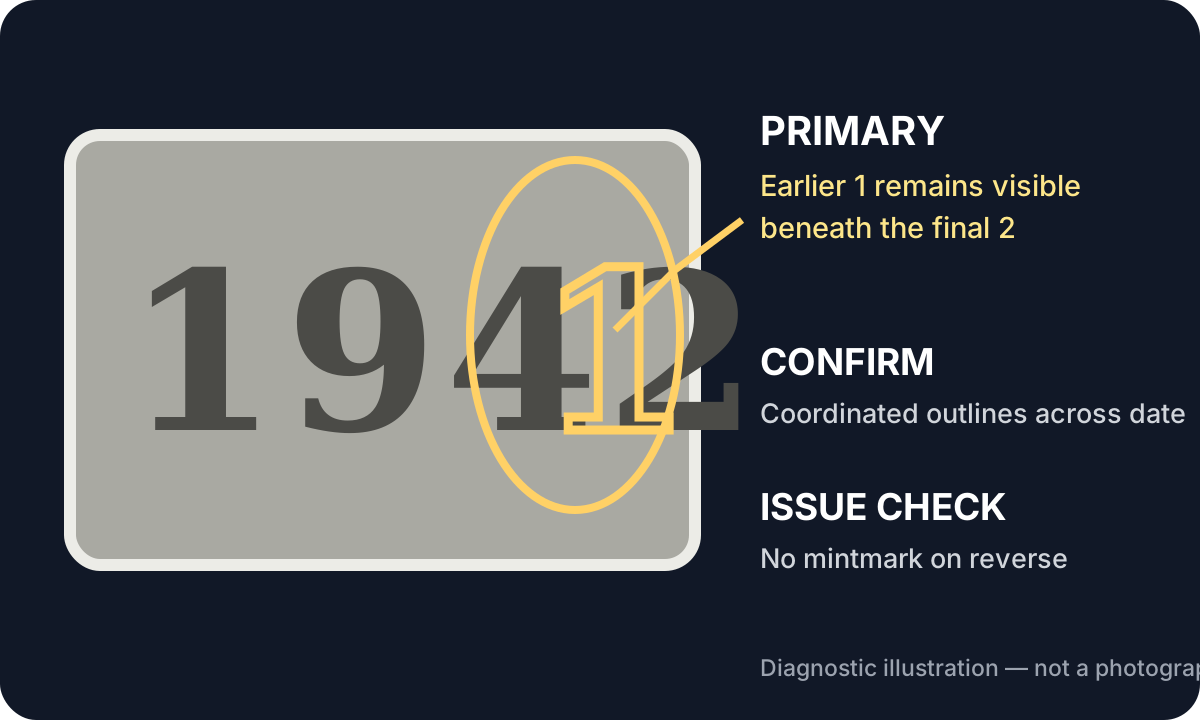
Diagnostic illustration — not a photograph.
Primary Marker — 1 Beneath the 2
The final digit should show structural remnants of a 1 under the 2, not simply a nick inside an ordinary numeral. Lighting from more than one direction helps separate raised hub detail from an incuse scratch.
Confirmation — The Whole Date
The variety resulted from impressions by differently dated hubs, so evidence is not confined to one random spot. Inspect all four numerals for the established doubled-date relationship. Wear may soften the finer traces, but a candidate must remain consistent with the FS-101 date layout.
What It Is Not
- 1942/1-D: a distinct Denver variety with a D mintmark on the reverse and subtler date diagnostics.
- Altered date: engraved or displaced metal used to imitate an underlying 1.
- Contact damage: isolated dents or scratches without the coordinated date pattern.
- Die deterioration: soft spreading that lacks the specific 1941-under-1942 geometry.
Authentication Caution
PCGS notes that both 1942/1 varieties are widely faked. Do not clean the coin. Professional authentication is strongly recommended before buying or selling one at a premium.
Image Credit
No exact forensic photograph with sufficiently clear reusable licensing was approved. CoinHunt created this original vector marker map from the cited facts. It does not represent grade, toning, surface texture, or die stage.
1942/1-D Mercury Dime FS-101
Documented Fact The Denver 1942/1-D is a separate FS-101 hubbed-date variety from the more dramatic Philadelphia 1942/1. Its date shows subtler remnants and doubled contours produced by mismatched 1941 and 1942 hub impressions. [3] [4]
Quick Hunt
- Confirm a D mintmark to the left of the fasces base on the reverse.
- Under magnification, inspect the 4 and final 2 for the recognized secondary date contours.
- Check the complete date rather than relying on one nick or lump.
- Compare with certified 1942/1-D images; do not use the stronger Philadelphia pattern as the template.
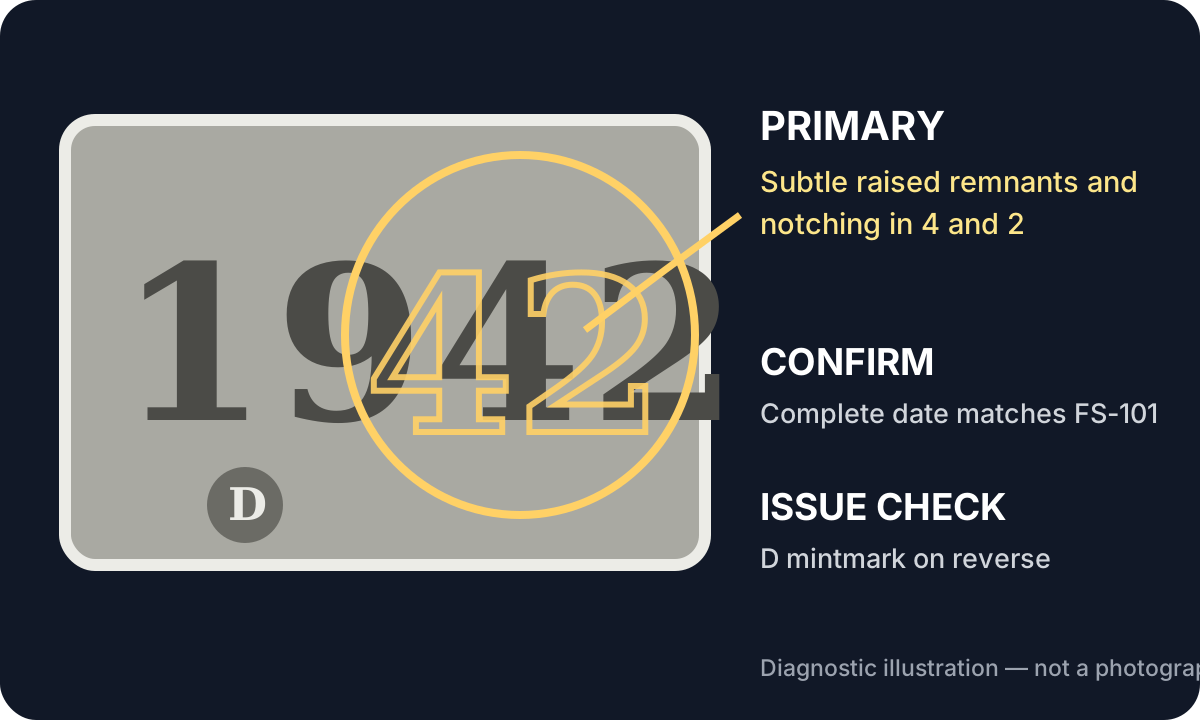
Diagnostic illustration — not a photograph.
Primary Marker — Subtle Doubled Date
The Denver overdate is less obvious than its Philadelphia counterpart. Look for raised remnants and notching in the final date digits that follow the documented FS-101 geometry. Tilt the coin under a single light source so luster does not masquerade as an extra outline.
Confirmation — Denver Reverse
The reverse must carry a D mintmark. The mintmark establishes the issue, but it does not establish the variety: most 1942-D dimes have a normal date. Require both the Denver reverse and the correct obverse date pattern.
What It Is Not
- Philadelphia 1942/1: the separate, more dramatic no-mintmark overdate.
- Ordinary 1942-D: a Denver dime without the FS-101 date pattern.
- Die erosion or glare: soft spreading or reflections without fixed raised detail.
- Altered date: scratches, tooling, or moved metal intended to imitate an overdate.
Authentication Caution
Both 1942/1 issues are frequently faked. Do not clean the coin. Match a candidate to certified close-ups and obtain professional authentication before a premium transaction.
Image Credit
No exact forensic photograph with sufficiently clear reusable licensing was approved. CoinHunt created this original vector marker map from the cited facts. It does not represent grade, toning, surface texture, or die stage.
Looking to buy or check current prices for this coin?Search it on CoinHunt →
Revision history
- : Integrated researched diagnostic illustrations, licensing metadata, attribution boundaries, and citations from duplicate variety pages. — Bradley Jones