Washington Quarter
How to Find a 1943 Doubled Die Obverse Washington Quarter
The 1943 Doubled Die Obverse Washington quarter is the scarcest major doubled die in the entire Washington quarter series. According to PCGS, only about 500 examples are believed to survive across the whole category, and PCGS itself has graded only about two dozen in the past twenty years.
CoinHunt helps you search inventory from multiple coin dealers in one place, compare available examples, and create a wishlist alert when the right coin is not currently listed.
What makes the 1943 Doubled Die Obverse quarter important to collectors?
A doubled die occurs when a working die receives more than one misaligned impression from the hub during manufacture, causing design elements to appear doubled on every coin struck from it. On the 1943 Philadelphia quarter, the doubling shows up most clearly in the motto IN GOD WE TRUST, with clear separation visible across several letters and a secondary image that’s rounded and fully formed rather than flat. The word LIBERTY also shows strong doubling, particularly near its opening letters, and doubling can appear around the date numerals as well.
Collectors recognize three cataloged varieties from this die pairing—FS-101, FS-102, and FS-103—with FS-103 showing the strongest, most dramatic doubling of the three. FS-101 and FS-102 remain desirable but show less pronounced doubling by comparison.
According to PCGS, roughly 220 of the estimated 500 surviving examples grade in Mint State, and only about 20 reach MS65 or finer—which is part of why the finest known examples bring extraordinary prices. CoinWeek reported that David Lawrence Rare Coins sold a PCGS MS67 example, one of only three known at that grade, for $22,250 in March 2020.
How to identify a 1943 Doubled Die Obverse quarter
Check IN GOD WE TRUST
Look for clear, rounded separation across several letters of the motto, rather than a flat or shelf-like doubling. This is the primary diagnostic collectors check first.
Check LIBERTY and the date
Strong doubling should also be visible on LIBERTY, especially near its first letters, and the date numerals may show doubling as well. Compare all of these points together against certified reference images.
Determine which FS variety you have
Because FS-103 shows the boldest doubling and is generally the most desirable of the three varieties, confirm which specific attribution applies to a candidate coin rather than assuming any doubling you see is the strongest version.
Rule out machine doubling
Machine (strike) doubling is common on many coins and looks flat and shelf-like, not the bold, rounded doubling of a genuine doubled die. If the doubling looks weak or shallow, it’s more likely machine doubling than a genuine FS-101/102/103 example.
Buying considerations
Certified versus raw coins
Given the rarity and value involved, and the fact that machine doubling is often mistaken for the genuine variety, a certified example from PCGS or NGC that explicitly attributes the coin to its specific FS number (or the general “Doubled Die Obverse” attribution for less dramatic examples) is strongly recommended. Verify the certification number on the grading service’s own website.
Understanding grades
Value rises steeply with grade, and especially steeply above MS65, where PCGS estimates only about 20 examples survive. Based on PCGS price guide data and results reported by major auction houses, prices for this variety range from modest premiums in low circulated grades up to several thousand dollars for higher Mint State examples, with the finest known coins reaching into five figures. Treat any specific dollar figure as a general guide rather than a guaranteed price.
Know the physical specifications
Per U.S. Mint records, a 1943 Washington quarter weighs 6.25 grams, measures 24.3mm in diameter, is struck in 90% silver and 10% copper, and has a reeded edge. These specifications describe the type generally; the doubling itself, not the metal content, is what distinguishes this variety.
Problem coins
Cleaning, scratches, and environmental damage reduce both eye appeal and value, the same as with any silver quarter from this era. A details-graded example can be a lower-cost way to own the variety, but the stated problem should be reflected in the price.
Suggested search terms and filters
Begin with a broad search: “1943 doubled die quarter,” “1943 DDO Washington quarter,” or “1943 FS-103 quarter.”
Then narrow by:
- Variety: FS-101, FS-102, or FS-103
- Grade: from circulated grades through MS67 and above
- Certification: PCGS, NGC, or “certified 1943 DDO”
Availability and pricing notes
Because the total surviving population is estimated at only around 500 across all grades, and PCGS has graded just a couple dozen examples over two decades, genuine examples—especially high-grade ones—don’t come up for sale often. Listings and past auction results don’t guarantee future prices, so compare the specific FS attribution, grade, and certification carefully before buying.
CoinHunt does not guarantee that every listing is authentic, accurately graded, or fairly priced. Authentication, grading, pricing, return policies, and fulfillment remain the responsibility of the dealer or marketplace offering the coin.
How the CoinHunt wishlist alert works
- Search for the coin. Enter “1943 Doubled Die Obverse Washington quarter” to search participating dealer inventory.
- Review the available matches. Compare listings by FS variety, grade, certification, and asking price.
- Add the search to your wishlist. Given how rarely genuine examples come to market, a wishlist alert is the most practical way to watch for one.
- Get notified about new matches. CoinHunt sends an alert when new dealer inventory matches your wishlist.
- Evaluate the coin before buying. Verify certification and photographs, and review the seller’s terms.
Frequently asked questions
What’s the difference between FS-101, FS-102, and FS-103?
They’re three separate cataloged doubled dies from 1943 Philadelphia quarters. FS-103 shows the strongest, most dramatic doubling of the three; FS-101 and FS-102 are still desirable but less pronounced.
How rare is this variety?
Very rare for the series. PCGS estimates only about 500 examples survive in total, with roughly 220 in Mint State and just 20 at MS65 or finer, and PCGS has graded only about two dozen examples in the past twenty years.
What’s the most this variety has sold for?
CoinWeek reported a PCGS MS67 example—one of only three known at that grade—sold for $22,250 at David Lawrence Rare Coins in March 2020. That record reflects an exceptional grade and shouldn’t be used as a typical value guide for lower-grade examples.
How do I tell it apart from machine doubling?
Genuine doubled die doubling on IN GOD WE TRUST and LIBERTY is bold and rounded, with clear separation between the primary and secondary images. Machine doubling looks flat and shelf-like and doesn’t carry the same premium.
What if no suitable coin is currently available?
Add “1943 Doubled Die Obverse Washington quarter” to your wishlist below. You’ll be notified when newly detected dealer inventory matches your search.
Illustrated diagnostic upgrades
The following marker cards consolidate CoinHunt’s researched variety diagnostics into this canonical guide. Each original vector is a diagnostic illustration, not a photograph, and its licensing record remains with the image asset.
1943 Washington Quarter Doubled Die Obverse FS-101
Documented Fact PCGS catalogs a major 1943 Philadelphia Washington quarter doubled die obverse as FS-101. It must not be confused with separate 1943-D or 1943-S doubled dies. [1] [2]
Quick Hunt
- Confirm 1943 with no reverse mintmark.
- Inspect IN GOD WE TRUST first, then LIBERTY and the date.
- Seek raised secondary contours with consistent separation.
- Exclude the D- and S-mint issues before comparing certified FS-101 markers.
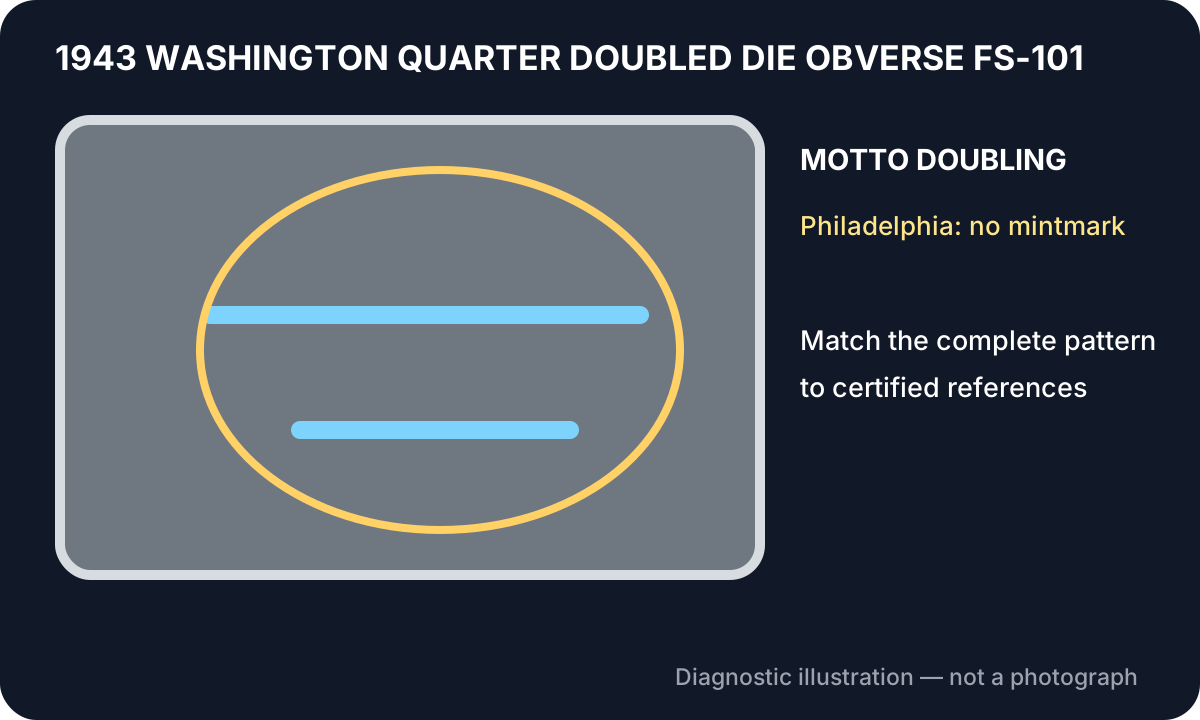
Diagnostic illustration — not a photograph.
Primary Diagnostic
The motto supplies the fastest screening area, but attribution should be confirmed across the affected obverse. A no-mintmark coin is essential for this Philadelphia page.
What It Is Not
1943-D and 1943-S doubled dies are distinct issues. Mechanical doubling produces flat shelving and must not be used as an FS-101 marker.
Authentication Caution
Use stable magnification and several lighting angles. Match the complete marker relationship to certified examples, do not clean the coin, and obtain professional attribution before paying a substantial premium.
Image Credit
No exact forensic photograph with sufficiently clear reusable licensing was approved. CoinHunt created this original vector marker map from the cited facts. It explains marker relationships and does not represent grade, color, surface texture, or die stage.
Looking to buy or check current prices for this coin?Search it on CoinHunt →
Revision history
- : Integrated researched diagnostic illustrations, licensing metadata, attribution boundaries, and citations from duplicate variety pages. — Bradley Jones