Roosevelt Dime
1968 Roosevelt Dime Errors, Varieties, Value and Identification
The 1968 Roosevelt dime carries John R. Sinnock’s Roosevelt portrait and torch reverse, the design used throughout the series. GetCoinHunt helps you search inventory from multiple coin dealers in one place, compare available examples, and create a wishlist alert when the right coin is not currently listed.
Design and history
John R. Sinnock designed both faces of the Roosevelt dime. His initials JS appear at the truncation of Roosevelt’s neck on the obverse, while the reverse combines a torch of liberty between an olive branch for peace and an oak branch for strength and independence. Those initials are part of the original design, not a secret mintmark or a later addition.
The 1968 dime belongs to the clad era before the P mintmark. Its standard composition is copper-nickel clad — outer layers of 75% copper/25% nickel bonded to a pure copper core, with a normal weight of 2.27 grams. Relevant production for 1968 includes Philadelphia circulation strikes without a mintmark, Denver D circulation strikes, and San Francisco S proofs. A normal piece shows a reeded clad edge with a visible copper core.
These basics are the fastest defense against a misrepresented listing. A missing copper stripe means something different on a pre-1965 silver coin than on a clad coin, and a proof must always be compared against other proofs rather than against worn circulation strikes.
Errors and varieties to know
The 1968 No-S proof dime is a famous missing-mintmark variety. It exists only as a proof — Philadelphia circulation strikes normally carried no mintmark in this period and are not errors. A candidate needs genuine proof surfaces and provenance consistent with a 1968 proof set; professional authentication is essential before you treat a claimed example as genuine.
The distinction that matters when comparing listings:
- A die variety, like the 1968 No-S proof, repeats on every coin struck from the same altered or doubled die and must match published diagnostics exactly.
- A mint error is an individual manufacturing accident — an off-center strike, a clipped planchet, a broadstrike, or a strike-through — that can occur on nearly any date.
- Post-mint damage happens after the coin leaves the Mint and is not a genuine feature at all.
PCGS Roosevelt Dime CoinFacts · NGC Roosevelt Dime Coin Explorer · NGC VarietyPlus
How to examine a 1968 Roosevelt dime
Start by identifying the strike type, mintmark, and composition. Mintmarks for this issue are none (Philadelphia), D, or S (proof). View the entire obverse, reverse, and edge in diffuse light before magnifying any single spot — a 5x to 10x loupe is enough for initial screening.
- On a genuine doubled die, secondary detail is raised, rounded, and repeats in the exact areas tied to a documented die. Mechanical or strike doubling is flat, shelf-like, and narrower than the main device.
- Die deterioration can thicken letters near the rim but does not reproduce a clean second design.
- A die gouge, chip, or crack fills with planchet metal and produces raised metal on the coin. A scratch or gouge made after striking cuts into the surface and often pushes metal toward its edge.
- Grease-filled dies create weak or missing letters without leaving a scraped trench; a claimed “missing letter” that shows abrasion, displaced metal, or tool marks is damage, not a Mint feature.
- A true off-center strike loses part of the design and usually shows an unstruck crescent. A genuine clipped planchet was incomplete before striking and should show compatible rim and edge effects. A broadstrike expands beyond normal diameter. A strike-through leaves a smooth depression or transferred texture from foreign material.
- Dryer coins, spooned edges, vise impressions, plating, acid treatment, and parking-lot damage all happened after manufacture and are not Mint errors.
Weight helps screen a candidate but cannot authenticate it by itself. Use a calibrated scale accurate to the hundredth of a gram and inspect the reeded edge; wear, dirt, and scale tolerance all affect a reading. Never grind the edge or use a destructive chemical test. If a coin’s composition appears genuinely abnormal, or if you suspect a documented variety, submit it to a respected grading service with error or variety attribution before treating any price claim as reliable.
Buying considerations
Certified versus raw coins
A certified coin has been authenticated, graded, and sealed in a holder by a third-party grading service such as PCGS or NGC. A raw coin is sold without that certification.
Before purchasing a certified coin:
- Confirm that the holder is from a recognized grading service.
- Verify the certification number through the grading service’s official website.
- Compare the holder’s photographs, when available, with the coin being offered.
- Remember that counterfeit grading holders also exist.
Understanding grades and condition
Collectors pay premiums for originality, high numerical grade, and sharply separated horizontal bands on the lower torch — called Full Bands by PCGS and Full Torch by NGC. That designation concerns strike quality, not an error. Cleaning, polishing, or artificial toning can erase much of a coin’s premium even on an otherwise better date.
When comparing listings, look at:
- How clearly Roosevelt’s portrait, the torch, and the lettering are struck
- Remaining luster on uncirculated examples
- Marks, scratches, rim damage, or discoloration
- Whether the assigned grade is supported by a recognized grading service
Problem coins
Watch for listings that describe an ordinary unmarked Philadelphia circulation dime, or a proof with a polished-off S mintmark, misrepresented as a genuine No-S proof. Problem coins are sometimes placed in holders with a details grade rather than a standard numerical grade — they can be a less expensive way to own the coin, but you should understand the stated problem and compare the asking price accordingly.
Suggested search terms and filters
Begin with a broad search: “1968 Roosevelt dime,” “1968-P Roosevelt dime,” “1968-D Roosevelt dime,” or “1968-S Roosevelt dime.”
Then narrow the results with terms that reflect your collecting goal:
- By mint mark: none (Philadelphia), D, or S (proof)
- By grade: circulated, MS60–MS70, or PR60–PR70 for proofs
- By certification: PCGS, NGC, or “certified 1968 Roosevelt dime”
- By feature: “1968 No-S proof” (compared against published diagnostics, not marketed on an internet nickname alone)
Availability and pricing notes
Most circulated clad-era examples are common and trade close to face value. Listings and asking prices do not necessarily represent completed-sale values — compare multiple examples, consider each coin’s grade and surface quality, and review recent market information before purchasing.
GetCoinHunt does not guarantee that every listing is authentic, accurately graded, or fairly priced. Authentication, grading, pricing, return policies, and fulfillment remain the responsibility of the dealer or marketplace offering the coin.
How the GetCoinHunt wishlist alert works
- Search for the coin. Enter “1968 No S Roosevelt Dime proof” to search participating dealer inventory.
- Review the available matches. Compare listings by grade, certification, condition, dealer, and asking price.
- Add the search to your wishlist. If the right example is not available, save “1968 No S Roosevelt Dime proof” as a wishlist item. Add grade, grading-service, or price preferences when those options are available.
- Get notified about new matches. When new dealer inventory matches your wishlist, GetCoinHunt sends an alert so you can review the listing before it disappears.
- Evaluate the coin before buying. Open the dealer’s listing, verify the certification and photographs, read the complete description, and review the seller’s terms.
Frequently asked questions
What is the 1968 Roosevelt dime made of?
Copper-nickel clad — outer layers of 75% copper/25% nickel bonded to a pure copper core, weighing 2.27 grams. This is a copper-nickel clad issue.
What is the 1968 No-S proof?
The 1968 No-S proof dime is a famous missing-mintmark variety. It exists only as a proof — Philadelphia circulation strikes normally carried no mintmark in this period and are not errors. A candidate needs genuine proof surfaces and provenance consistent with a 1968 proof set; professional authentication is essential before you treat a claimed example as genuine.
Are there any other officially recognized rare varieties for 1968?
Beyond what is described above, no other major variety is singled out for 1968 in the principal PCGS and NGC series references used for this guide. Individual mint errors can still occur on any date and should be evaluated on their own diagnostics.
How do I tell a die variety from a mint error or damage?
A die variety repeats on every coin struck from the same die and shows raised, rounded, repeatable detail. A mint error is an individual manufacturing accident, such as an off-center strike or a clipped planchet. Post-mint damage happens after the coin leaves the Mint and is not a genuine feature.
Is a 1968 Roosevelt dime worth much?
Most ordinary circulated 1968 dimes are common, valued for silver content (pre-1965) or close to face value (clad). Value concentrates in high-grade uncirculated coins, certified proofs, and verified examples of the 1968 No-S proof.
What if no suitable coin is currently available?
Add “1968 No S Roosevelt Dime proof” to your wishlist below. You’ll be notified when newly detected dealer inventory matches your search.
Illustrated diagnostic upgrades
The following marker cards consolidate CoinHunt’s researched variety diagnostics into this canonical guide. Each original vector is a diagnostic illustration, not a photograph, and its licensing record remains with the image asset.
1968 No S Proof Roosevelt Dime FS-501
Documented Fact The 1968 No S is a proof Roosevelt dime struck without the S mintmark expected on San Francisco proofs. PCGS identifies it as FS-501. [1] [2]
Quick Hunt
- Establish that the coin is a genuine proof, not a circulation strike.
- Inspect the obverse mintmark position above the date and to the right of Roosevelt’s neck.
- Confirm that no S is present and that the surface has not been altered.
- Compare the whole coin with certified examples and submit any credible candidate for authentication.
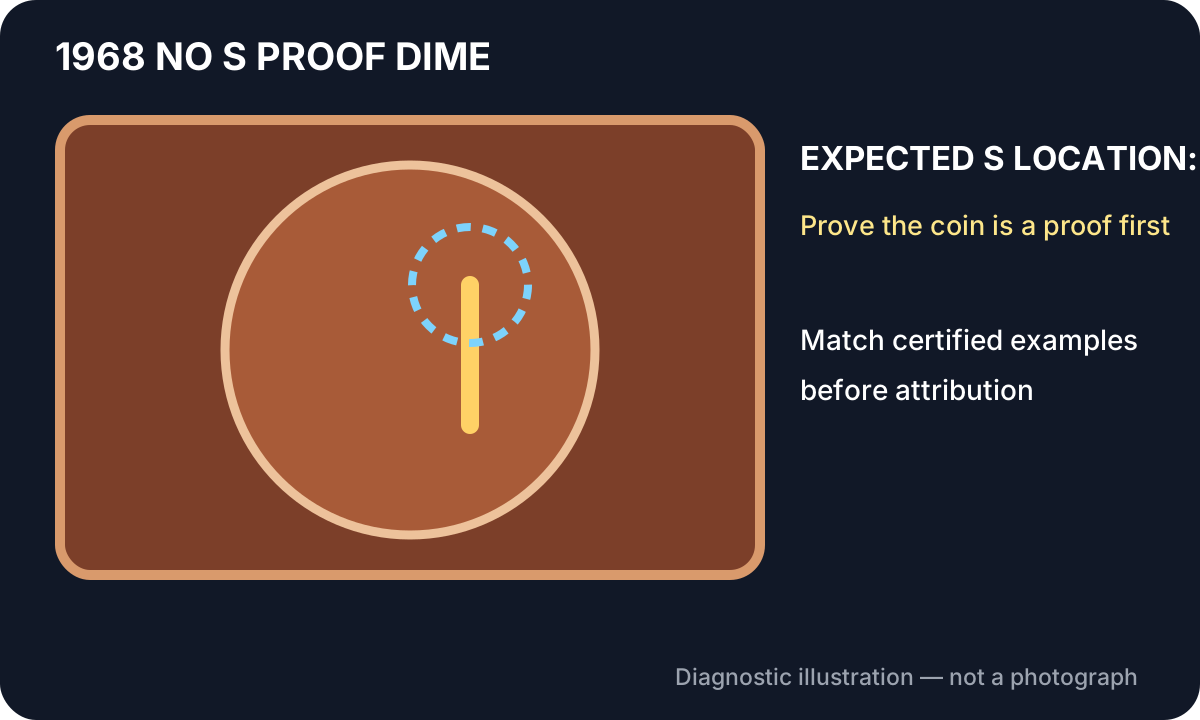
Diagnostic illustration — not a photograph.
Proof Status Comes First
“No S” is meaningful only with proof manufacture. Mirrored fields alone are not conclusive because polished or prooflike circulation coins can mislead. Check strike quality, rims, surfaces, and provenance.
What It Is Not
An ordinary 1968-D circulation dime, a damaged coin with an removed mintmark, or a normal proof with a weak but present S is not this variety.
Image Credit
CoinHunt created this original vector marker map because no exact reusable forensic photograph was approved.
Looking to buy or check current prices for this coin?Search it on CoinHunt →
Revision history
- : Integrated researched diagnostic illustrations, licensing metadata, attribution boundaries, and citations from duplicate variety pages. — Bradley Jones