Eisenhower Dollar
1971 Eisenhower Dollar Errors, Varieties and Value
The dollar coin had been dormant for nearly a decade when the Mint revived it in 1971 to honor Dwight D. Eisenhower, the World War II Allied commander and 34th president who had died the year before. It was a big coin for a big legacy — at 38.1mm across, the Eisenhower dollar dwarfs the quarters and half dollars collectors were used to, and it launched with two genuinely different forms: a copper-nickel clad version meant for the cash register, and a 40% silver version meant only for collectors. That two-track structure carries through the whole eight-year series, right up to its final 1978 issue. GetCoinHunt helps you search inventory from multiple coin dealers in one place, compare available examples, and create a wishlist alert when the right coin is not currently listed.
Design and history
Chief Engraver Frank Gasparro designed both sides of the new dollar. The obverse carries a bust of Eisenhower; the reverse adapts the Apollo 11 mission patch — an eagle landing on the moon, an eagle clutching an olive branch, with the Earth visible in the distance — a nod to Apollo 11 astronaut Michael Collins, who had a hand in the mission insignia’s design. Philadelphia and Denver struck the copper-nickel clad version for circulation: 22.68 grams, 38.1mm, with a reeded edge, made of an outer layer of 75% copper/25% nickel bonded to a pure copper core. San Francisco struck a 40% silver version — about 24.59 grams, same diameter and reeded edge — sold directly to collectors rather than released into commerce. Uncirculated silver Ikes came in blue Mint packaging (hence “Blue Ikes”), and silver proofs came in brown boxes (“Brown Ikes”); those nicknames describe packaging, not a coin variety.
Errors and varieties to know
The best-known 1971 variety is the 1971-D Friendly Eagle, catalogued by CONECA and PCGS as FS-901. On this die, small differences in the eagle’s brow, eye, and wing feathers give the bird a softer, more approachable look than the standard reverse — hence the nickname. Confirming it requires comparing the full set of documented reverse diagnostics side by side with a reference photo, not just deciding an eagle “looks friendly” because of wear or a soft strike.
On the collector side, 1971-S silver proofs include the Peg Leg variety, named for a malformed serif on the R in LIBERTY that makes the letter resemble a leg with a peg foot. PCGS and NGC also attribute several 1971-S proof doubled-die obverses, plus a doubled-die reverse (FS-801). Each of these — Peg Leg, doubled die, proof finish, silver composition — is a separate, independently verifiable characteristic, and a listing that blurs them together is a listing to be skeptical of.
Because 1971 and much of 1972 saw persistently soft strikes at the Mint, weak detail in Eisenhower’s hair above the ear is common on clad business strikes from this year. NGC treats that softness as a routine strike-quality issue rather than evidence of a die error, and it shouldn’t be marketed as one — a distinction that matters even more the following year, when 1972’s genuine Type 1, 2, and 3 reverse varieties give collectors an actual die-level puzzle to solve.
As with any attributed variety across this series, the line between a genuine die feature and simple damage or alteration matters for value. This reference guide to documented counterfeit and altered U.S. coins covers the broader authentication principles that apply whenever a claimed variety carries a real premium.
How to examine a 1971 Eisenhower dollar
- Look for the Friendly Eagle’s diagnostic points around the eye, brow, and wing on 1971-D coins, comparing against certified reference images rather than a general impression of “friendliness.”
- On 1971-S silver proofs, examine the R in LIBERTY under magnification for the Peg Leg serif defect.
- True doubled dies show raised, rounded, repeatable secondary detail; flat, shelf-like doubling is mechanical doubling from the striking press, not a die variety.
- Raised lines across the field are die cracks; incuse marks are scratches or handling damage, not errors.
- Weigh the coin: clad dollars should land near 22.68 grams, silver dollars near 24.59 grams. A coin that’s off in weight, or has an inconsistent edge color, deserves nondestructive composition testing rather than a guess.
Don’t clean a candidate coin — cleaning can strip away the fine detail needed to confirm a genuine variety or catch a fabricated one.
Buying considerations
Certified versus raw coins
For an attributed variety like the Friendly Eagle or Peg Leg, buy certified where possible and check the certification number against the grading service’s public records. Raw coins sold as “Friendly Eagle” or “Peg Leg” without certification are common enough that an inexperienced seller may simply be misreading ordinary wear.
Understanding grades and condition
Clad 1971 and 1971-D dollars are common in circulated grades and readily available in typical Mint State. Silver 1971-S uncirculated and proof coins are more consistently found in higher grades since they were sold directly to collectors and rarely mishandled. Large, open fields on this coin show bag marks easily, so compare Mint State listings carefully for contact marks on Eisenhower’s cheek and the fields around the portrait.
Problem coins
Cleaned or environmentally toned examples turn up among circulated clad dollars pulled from old holdings. A details-graded coin can be an inexpensive way to own the date, but confirm the stated problem before paying a straight-grade price.
Suggested search terms and filters
Start broad: “1971 Eisenhower dollar,” “1971-D Ike dollar,” “1971-S silver Eisenhower dollar,” or “1971 Friendly Eagle.”
Then narrow by:
- Mint: Philadelphia (no mark), D (Denver), or S (San Francisco)
- Composition: copper-nickel clad or 40% silver
- Variety: Friendly Eagle, Peg Leg, doubled die, or regular strike
- Certification: PCGS, NGC, or raw
Availability and pricing notes
Ordinary clad 1971 and 1971-D dollars are common and inexpensive at any circulated or typical Mint State grade. Silver 1971-S coins carry a modest premium over clad simply for their silver content and collector-issue status, and prices rise meaningfully for certified, well-documented examples of the Friendly Eagle or Peg Leg varieties. Compare completed sales for the specific attribution, mint, composition, and grade before assuming an asking price reflects the market.
GetCoinHunt does not guarantee that every listing is authentic, accurately graded, or fairly priced. Authentication, grading, pricing, return policies, and fulfillment remain the responsibility of the dealer or marketplace offering the coin.
How the GetCoinHunt wishlist alert works
- Search for the coin. Enter “1971 Eisenhower Dollar” to search participating dealer inventory.
- Review the available matches. Compare listings by mint, composition, variety attribution, and price.
- Add the search to your wishlist. If the right example isn’t available, save “1971 Eisenhower Dollar” as a wishlist item, with mint or variety preferences where available.
- Get notified about new matches. GetCoinHunt sends an alert when new dealer inventory matches your wishlist.
- Evaluate the coin before buying. Verify certification and photographs, read the full listing, and review the seller’s terms.
Frequently asked questions
What’s the difference between clad and silver 1971 Eisenhower dollars?
Clad dollars, struck at Philadelphia and Denver, are copper-nickel over a copper core and were released into circulation. Silver dollars, struck only at San Francisco, are 40% silver, weigh more, and were sold directly to collectors — they never circulated as money.
What is the Friendly Eagle variety?
It’s a 1971-D reverse die, catalogued as FS-901, where small differences around the eagle’s brow, eye, and wing give the bird a softer appearance than the standard reverse.
Is weak hair detail on a 1971 Ike dollar an error?
No. The Mint’s dies were producing soft strikes broadly in 1971 and much of 1972, so weak detail above Eisenhower’s ear is a common strike-quality trait, not a distinct die error.
Are 1971-S silver proofs rare?
No, they’re a regular collector issue with substantial mintages. Value concentrates in specific attributed varieties like the Peg Leg or documented doubled dies, not in the base silver proof itself.
What if no suitable coin is currently available?
Add “1971 Eisenhower Dollar” to your wishlist below. You’ll be notified when newly detected dealer inventory matches your search.
Illustrated diagnostic upgrades
The following marker cards consolidate CoinHunt’s researched variety diagnostics into this canonical guide. Each original vector is a diagnostic illustration, not a photograph, and its licensing record remains with the image asset.
1971-D Friendly Eagle Eisenhower Dollar FS-901
Documented Fact FS-901, also called the Friendly Eagle, is a 1971-D Eisenhower dollar reverse distinguished by an eagle without the usual eyebrow and additional Earth, lettering, crater, and feather differences. [1] [2]
Quick Hunt
- Confirm the 1971-D obverse.
- On the reverse, inspect the eagle’s eye for the absent eyebrow.
- Check the top tail-feather separation and the Earth/crater details against certified examples.
- Require the complete Friendly Eagle marker set; do not attribute from a weak eye alone.
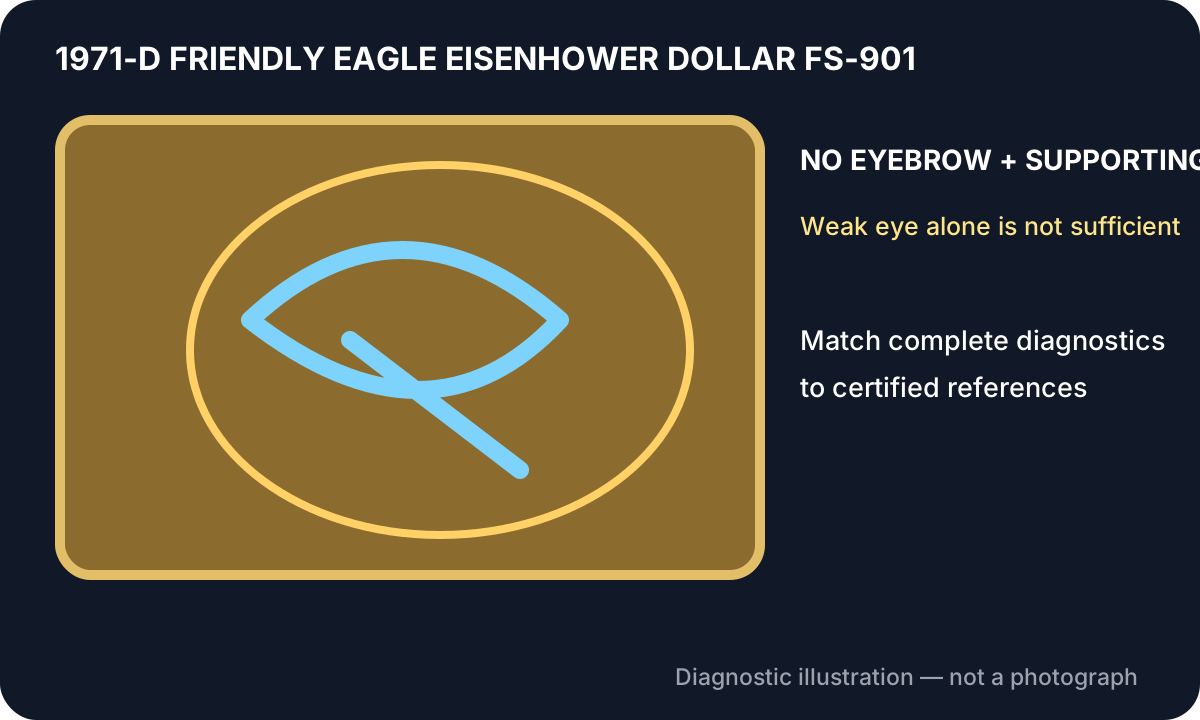
Diagnostic illustration — not a photograph.
Primary Diagnostic
The eyebrow-free expression supplies the nickname, but it is not sufficient by itself. PCGS notes supporting differences in the tail feathers, lettering/crater area, and the flatter Earth with raised Andes.
What It Is Not
Weak strike or wear can erase an eyebrow on a normal reverse. A genuine FS-901 must preserve the other RDV-006 relationships.
Authentication Caution
Use stable magnification and several lighting angles. Match the complete diagnostic relationship to certified examples, do not clean or alter the coin, and obtain professional authentication before paying a substantial premium.
Image Credit
No exact forensic photograph with sufficiently clear reusable licensing was approved. CoinHunt created this original vector marker map from the cited facts. It explains marker relationships and does not represent grade, color, surface texture, or die stage.
Looking to buy or check current prices for this coin?Search it on CoinHunt →
Revision history
- : Integrated researched diagnostic illustrations, licensing metadata, attribution boundaries, and citations from duplicate variety pages. — Bradley Jones