Eisenhower Dollar
1972 Eisenhower Dollar Type 1, 2 and 3: Errors, Varieties and Value
Most Eisenhower dollar dates are collected by mint and composition alone. 1972 is the exception: Philadelphia struck three distinct reverse dies that year, and telling them apart is the single most consequential variety-hunting skill in the entire series. Coming right after the debut 1971 Ike dollar, 1972 turns the same eagle-on-the-moon design into a genuine three-way puzzle. GetCoinHunt helps you search inventory from multiple coin dealers in one place, compare available examples, and create a wishlist alert when the right coin is not currently listed.
Design and history
The design lineup is unchanged from 1971: Frank Gasparro’s Eisenhower obverse, paired with his adaptation of the Apollo 11 mission patch — an eagle landing on the moon — for the reverse. Philadelphia and Denver struck copper-nickel clad dollars for circulation (22.68 grams, 38.1mm, reeded edge), while San Francisco struck 40% silver dollars (about 24.59 grams, same diameter and edge) sold directly to collectors in uncirculated and proof format. What changed in 1972 wasn’t the design concept but its execution at the die level: the Philadelphia Mint revised the reverse hub more than once during the year, producing three collectible states of the earth above the eagle.
Errors and varieties to know
The Type 1, Type 2, and Type 3 reverses are distinguished by how the Earth’s geography is rendered above the eagle, particularly Florida and the visible Caribbean islands:
- Type 1 shows Florida only partially defined, with the islands generally indistinct.
- Type 2 uses a proof-style earth hub with a different island arrangement. PCGS identifies this as coming from a single reverse die, making it the scarcest of the three and the year’s key variety.
- Type 3 has a revised, more clearly defined earth, with a stronger Florida outline and sharper island detail.
These are useful starting descriptions, not a substitute for comparing a candidate coin against certified side-by-side attribution photographs. Wear and weak strikes can blur or erase islands entirely on any of the three types, so a coin missing islands is not automatically a Type 2 — it may simply be a worn or softly struck Type 1 or Type 3.
Denver’s 1972-D circulation dollars don’t follow the same Type 1/2/3 collecting framework used for Philadelphia. On the collector side, San Francisco’s 1972-S 40% silver proofs include a recognized doubled-die obverse, FS-101 — confirmed by rounded, repeatable hub doubling, not the mirror-field reflections that can make ordinary proof lettering look doubled at a glance.
That same mirror-field caution carries over into 1973, where San Francisco’s 1973-S silver proof doubled-die obverse requires the same careful standard before attribution.
How to examine a 1972 Eisenhower dollar
- Start with the earth above the eagle: note whether Florida and the islands are indistinct (Type 1), rearranged with a proof-style hub (Type 2), or sharply redefined (Type 3).
- Rule out wear before attributing a type — a worn Type 1 or Type 3 can lose island detail and superficially resemble a different type.
- On 1972-S silver proofs, check for FS-101 doubling using raised, rounded, repeatable secondary detail as the standard, not reflective glare off mirrored proof fields.
- Weigh the coin: clad should read near 22.68 grams, silver near 24.59 grams.
- Avoid cleaning a candidate; even light polishing can obscure the fine earth detail that separates the three types.
Buying considerations
Certified versus raw coins
Because Type 2 is the scarcest of the three and commands the largest premium, buy it certified whenever possible. A raw coin sold as “Type 2” deserves comparison against multiple certified reference photos before you accept the attribution — sellers occasionally mislabel a worn Type 1 as Type 2 because of missing islands alone.
Understanding grades and condition
Type 1 and Type 3 dollars are common in circulated and typical Mint State grades. Type 2 is scarcer at every grade level, and pricing rises faster with grade than it does for the other two types. As with the rest of the series, this is a large coin with open fields, so contact marks accumulate easily even on lightly circulated pieces.
Problem coins
Cleaned or artificially toned examples are common enough among 1972 clad dollars pulled from old accumulations. A cleaned coin can still be correctly typed, but expect to pay less than for a problem-free example of the same type and grade.
Suggested search terms and filters
Start broad: “1972 Eisenhower dollar,” “1972 Type 2 Ike dollar,” “1972-D Ike dollar,” or “1972-S silver Eisenhower dollar.”
Then narrow by:
- Mint: Philadelphia (no mark), D (Denver), or S (San Francisco)
- Reverse type: Type 1, Type 2, or Type 3 (Philadelphia only)
- Composition: copper-nickel clad or 40% silver
- Certification: PCGS, NGC, or raw
Availability and pricing notes
Ordinary 1972 and 1972-D clad dollars, in either Type 1 or Type 3, are common and inexpensive. The Type 2 reverse is the series’ scarcest regularly collected circulation variety and commands a substantial premium over the other two types at comparable grades, particularly in higher Mint State. Silver 1972-S coins trade near typical San Francisco collector-issue levels unless they carry the attributed doubled-die obverse. Compare completed sales for the exact type, mint, composition, and grade before assuming an asking price is fair.
GetCoinHunt does not guarantee that every listing is authentic, accurately graded, or fairly priced. Authentication, grading, pricing, return policies, and fulfillment remain the responsibility of the dealer or marketplace offering the coin.
How the GetCoinHunt wishlist alert works
- Search for the coin. Enter “1972 Eisenhower Dollar” to search participating dealer inventory.
- Review the available matches. Compare listings by reverse type, mint, composition, and price.
- Add the search to your wishlist. If the right example isn’t available, save “1972 Eisenhower Dollar” as a wishlist item, noting Type 2 if that’s your target.
- Get notified about new matches. GetCoinHunt sends an alert when new dealer inventory matches your wishlist.
- Evaluate the coin before buying. Verify certification and photographs, read the full listing, and review the seller’s terms.
Frequently asked questions
What makes 1972 different from other Ike dollar years?
Philadelphia struck three distinct reverse dies that year — Type 1, Type 2, and Type 3 — distinguished by how the earth and islands above the eagle are rendered. No other date in the series has this three-way regularly collected split.
Which type is the rarest?
Type 2, struck from a single reverse die according to PCGS, is the scarcest and most valuable of the three.
Can wear make a Type 1 look like a Type 2?
Wear more often erases island detail than rearranges it, so a heavily worn Type 1 can lose enough detail to be mistaken for Type 2 by an inexperienced buyer. Always compare against certified reference photos rather than relying on missing islands alone.
Does Denver have the same Type 1/2/3 varieties as Philadelphia?
No. The three-type collecting structure applies to Philadelphia’s 1972 dollars. Denver’s 1972-D dollars are collected simply by mint and composition.
What if no suitable coin is currently available?
Add “1972 Eisenhower Dollar” to your wishlist below. You’ll be notified when newly detected dealer inventory matches your search.
Illustrated diagnostic upgrades
The following marker cards consolidate CoinHunt’s researched variety diagnostics into this canonical guide. Each original vector is a diagnostic illustration, not a photograph, and its licensing record remains with the image asset.
1972 Eisenhower Dollar Type 2 Reverse FS-901
Documented Fact FS-901 is the 1972 Philadelphia circulation-strike Eisenhower dollar with the Type 2 reverse normally associated with proof-style reverse dies. [1] [2]
Quick Hunt
- Confirm a 1972 copper-nickel dollar with no mintmark.
- Inspect Earth above the eagle, especially Florida and the Caribbean islands.
- Compare the Type 2 island arrangement and Earth relief with certified FS-901 images.
- Exclude the common Type 1 and Type 3 reverses using the entire globe, not one worn detail.
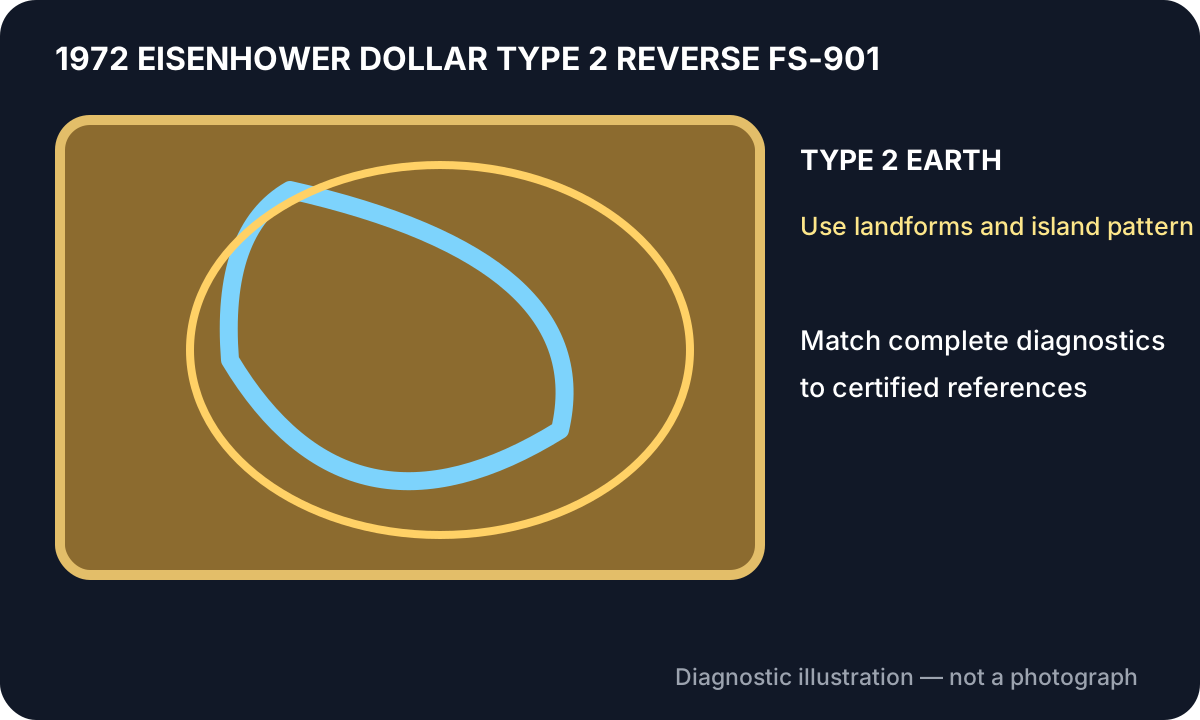
Diagnostic illustration — not a photograph.
Primary Diagnostic
The globe is decisive. Type 2 shows the proof-style Earth treatment and lacks the complete island configuration seen on Type 3. Wear can erase small islands, so the broader landform and relief pattern must also agree.
What It Is Not
A worn Type 1 or Type 3 can appear to lack islands. Surface loss is not a reverse type; compare several fixed globe features before attribution.
Authentication Caution
Use stable magnification and several lighting angles. Match the complete diagnostic relationship to certified examples, do not clean or alter the coin, and obtain professional authentication before paying a substantial premium.
Image Credit
No exact forensic photograph with sufficiently clear reusable licensing was approved. CoinHunt created this original vector marker map from the cited facts. It explains marker relationships and does not represent grade, color, surface texture, or die stage.
Looking to buy or check current prices for this coin?Search it on CoinHunt →
Revision history
- : Integrated researched diagnostic illustrations, licensing metadata, attribution boundaries, and citations from duplicate variety pages. — Bradley Jones