Roosevelt Dime
How to Find a 1982 No Mint Mark Roosevelt Dime
The 1982 No Mint Mark Roosevelt dime is the first mint-mark omission error known on a United States coin made for general circulation. A single Philadelphia working die was approved for production without its “P” mintmark, and the resulting coins entered circulation before anyone noticed.
GetCoinHunt helps you search inventory from multiple coin dealers in one place, compare available examples, and create a wishlist alert when the right coin is not currently listed.
Design and history
The Roosevelt dime has carried John R. Sinnock’s original 1946 design since its debut. Sinnock designed both faces: his initials, JS, appear at the truncation of Roosevelt’s neck on the obverse, and the reverse combines a torch of liberty with an olive branch for peace and an oak branch for strength and independence. Those initials are part of the design—not a secret mintmark or later addition.
The 1982 issue belongs to the modern clad era. Its standard composition is copper-nickel clad for circulation issues, with a normal weight of 2.27 grams; silver proofs would not return to designated collector sets until 1992. Relevant production includes Philadelphia (P) and Denver (D) circulation strikes and San Francisco (S) collector proofs. A normal piece has a reeded, clad edge with a visible copper-colored core. Philadelphia began adding a small “P” mintmark to circulating dimes in 1980, a detail that is essential context for this date’s error.
Errors and varieties to know
In 1982, at least one working die for the Roosevelt dime was prepared and hubbed without that “P” mintmark, and it was never caught during inspection. An unknown quantity of dimes struck from that die reached circulation.
The error was first confirmed in late 1982, with a concentration of examples turning up in and around Sandusky, Ohio. The high cash volume at a nearby amusement park is often credited with surfacing many of the coins quickly. The geographic clustering suggests the error dies were used on a limited run rather than distributed nationwide, though the exact mintage is unknown because the coins were never tracked separately from normal 1982 Philadelphia dimes.
Collectors recognize two strike classes among No Mint Mark examples, based on the sharpness of the design rather than the missing mintmark itself:
- Strong strike: rims and lettering appear crisp, matching a normally struck dime.
- Weak strike: outer design details appear flattened, with some elements nearly obliterated.
Sharply struck (strong) examples are more desirable to collectors and typically bring a premium over weakly struck coins in the same technical grade.
Beyond the No-P error, no other major error or variety is singled out for 1982 Roosevelt dimes in the principal PCGS and NGC series references.
How to examine a 1982 Roosevelt dime
Check the reverse first, then confirm the coin is genuinely from 1982 and not a coin where the mintmark has simply worn away or been altered.
Confirm there is no mint mark
On a normal 1982 Philadelphia dime, a small “P” appears above the date on the obverse, just above the “2” in “1982.” On the error coin, that area is smooth, with no trace of a mintmark ever having been punched.
Heavy wear can make a “P” hard to see on an ordinary dime, so don’t assume a worn, illegible mint-mark area is the same as a genuine No Mint Mark error. Use magnification and compare the surface texture: a worn-away mintmark usually leaves some trace of metal disturbance, while the genuine error shows a smooth, unbroken field consistent with the rest of the die.
Rule out other explanations
Dimes from Denver (“D”) and San Francisco proofs (“S”) are not part of this error—only coins that should read “P” and don’t. Also confirm the date reads 1982; genuine No-P dimes are consistently attributed to that year.
Buying considerations
Certified versus raw coins
Because the difference between a genuine error and a worn or damaged normal coin can be subtle, certification from PCGS or NGC is worth the cost for anything beyond a low-grade, inexpensive example. Before buying a certified coin, verify the certification number on the grading service’s own website and compare the holder’s photos with the coin being offered.
Understanding strong versus weak strikes
Ask the seller which strike class the coin represents, and expect strong-strike examples to cost more than weak-strike examples in a comparable grade. A listing that doesn’t specify strike quality may still be genuine, but it’s worth asking before paying a premium price.
Problem coins
Watch for cleaning, environmental damage, scratches, and rim damage, which reduce both eye appeal and value regardless of strike quality. A details-graded example can be a lower-cost way to own the variety, but the stated problem should be reflected in the asking price.
Suggested search terms and filters
Begin with a broad search: “1982 No Mint Mark dime,” “1982 No P dime,” or “1982 no mintmark Roosevelt dime.”
Then narrow by:
- Strike quality: strong strike, weak strike
- Grade: XF, AU, MS, with Gem Mint State (MS65 and above) commanding the largest premiums
- Certification: PCGS, NGC, or “certified 1982 No-P dime”
Availability and pricing notes
Prices vary substantially by strike quality and grade. Circulated examples in About Uncirculated to Extra Fine condition have traded in the neighborhood of $30, while Mint State examples—especially strong strikes in Gem condition or better—can bring $300 or more, with steep premiums in the highest certified grades. Listings and asking prices don’t necessarily reflect completed-sale values, so compare multiple examples before buying.
GetCoinHunt does not guarantee that every listing is authentic, accurately graded, or fairly priced. Authentication, grading, pricing, return policies, and fulfillment remain the responsibility of the dealer or marketplace offering the coin.
How the GetCoinHunt wishlist alert works
- Search for the coin. Enter “1982 No Mint Mark Roosevelt dime” to search participating dealer inventory.
- Review the available matches. Compare listings by strike quality, grade, certification, and asking price.
- Add the search to your wishlist. If the right example isn’t available, save it as a wishlist item.
- Get notified about new matches. GetCoinHunt sends an alert when new dealer inventory matches your wishlist.
- Evaluate the coin before buying. Verify certification and photographs, and review the seller’s terms.
Frequently asked questions
Why does the 1982 No Mint Mark dime exist?
A Philadelphia working die was hubbed and approved for production without its “P” mintmark, an oversight that wasn’t caught before the coins reached circulation.
How many 1982 No Mint Mark dimes exist?
The exact number is unknown. Estimates for the coins that escaped into circulation run into the thousands, with a notable concentration first surfacing around Sandusky, Ohio, in late 1982.
What’s the difference between a strong and weak strike?
Strong strikes show crisp rims and lettering, similar to a normally struck dime. Weak strikes show flattened, sometimes nearly obliterated outer details. Strong strikes are more desirable.
How do I know a coin isn’t just worn smooth where the mint mark would be?
Examine the mint-mark area under magnification. A genuine No-P error shows a smooth, undisturbed field consistent with the surrounding die surface, rather than the kind of metal disturbance typically left by wear or an added/removed mark.
Is this the only modern no-mintmark error?
It’s the first and most famous circulation-strike example of this specific error type, which is part of why it draws strong collector demand even though it’s a 20th-century coin rather than an antique.
What if no suitable coin is currently available?
Add “1982 No Mint Mark Roosevelt dime” to your wishlist below. You’ll be notified when newly detected dealer inventory matches your search.
Illustrated diagnostic upgrades
The following marker cards consolidate CoinHunt’s researched variety diagnostics into this canonical guide. Each original vector is a diagnostic illustration, not a photograph, and its licensing record remains with the image asset.
1982 No P Roosevelt Dime Strong FS-501
Documented Fact The 1982 No P is a Philadelphia circulation strike made without the P mintmark that had been required on dimes since 1980. This page covers the Strong FS-501 form. [1] [2]
Quick Hunt
- Confirm the 1982 date and normal circulation-strike manufacture.
- Inspect the obverse above the date, where the P should appear.
- On the Strong form, confirm a clean, naturally struck empty mintmark area.
- Reject filled, weak, abraded, or removed mintmarks; compare with certified FS-501 examples.
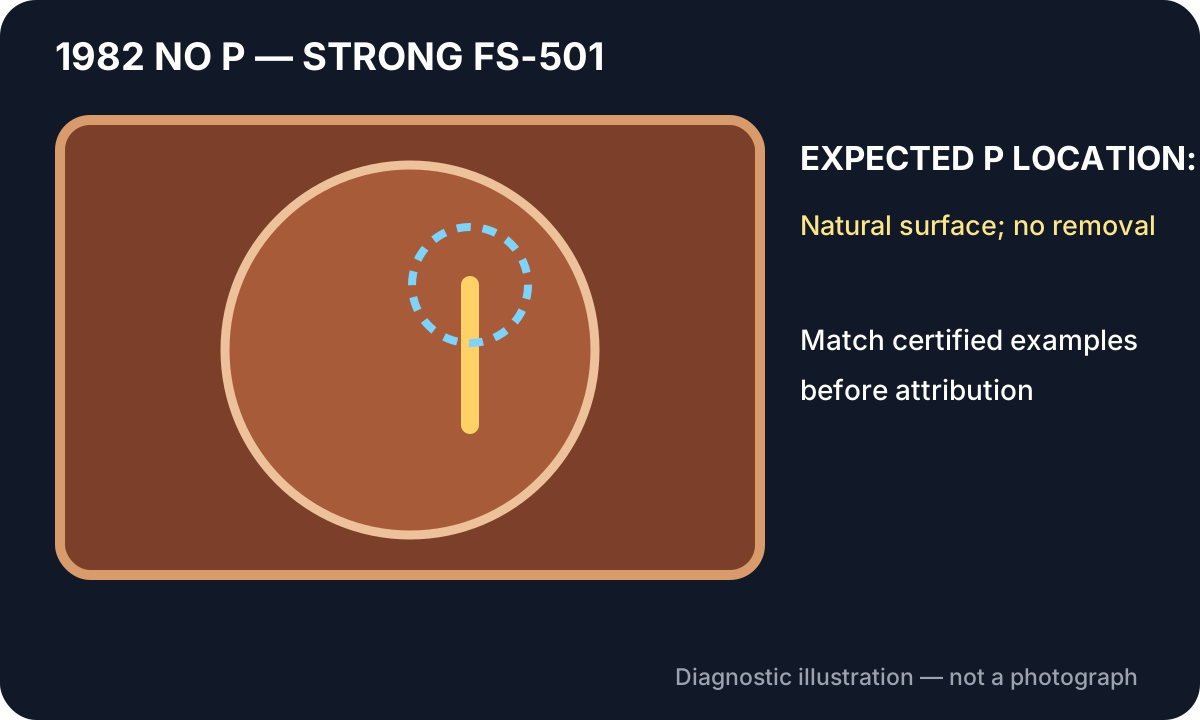
Diagnostic illustration — not a photograph.
Strong Versus Weak
PCGS distinguishes Strong and Weak No P varieties. FS-501 is the Strong attribution. Do not assign it merely because a normal P is faint or hidden by damage.
What It Is Not
This is not a proof No S issue. It is a business strike from Philadelphia that should have carried P, and it must retain natural surface texture in the empty location.
Image Credit
CoinHunt created this original vector marker map because no exact reusable forensic photograph was approved.
Looking to buy or check current prices for this coin?Search it on CoinHunt →
Revision history
- : Integrated researched diagnostic illustrations, licensing metadata, attribution boundaries, and citations from duplicate variety pages. — Bradley Jones