Sacagawea Dollar
How to Find a 2000-P Sacagawea Dollar/Washington Quarter Mule
The 2000-P Sacagawea dollar/Washington quarter mule is arguably the most famous mint error in American numismatics. It combines a Washington quarter obverse with a Sacagawea dollar reverse on a golden dollar-coin planchet—two designs that were never supposed to appear on the same coin. Only about two dozen examples are known. A search returning no results for this coin is the expected outcome.
CoinHunt helps you search inventory from multiple coin dealers in one place, and lets you save a wishlist alert for coins that, realistically, rarely appear in routine dealer inventory.
What makes the 2000-P Sacagawea dollar/Washington quarter mule important to collectors?
In numismatics, a “mule” is a coin struck from two dies that were never intended to be paired together—typically an obverse die from one denomination or design combined with a reverse die from another. Mules are exceptionally rare on modern U.S. coinage because of the Mint’s production controls, which is exactly what makes this error so significant: it is the first mule ever released into general circulation by the United States Mint in the modern era.
The error coin pairs a Washington quarter obverse—specifically from the 50 State Quarters program—with the standard Sacagawea dollar reverse, struck on the golden dollar coin’s own planchet rather than a quarter’s. According to numismatic trade-press coverage, an Arkansas collector, Frank Wallis, is credited with discovering the first known example in 2000, the same year the error was produced, and further examples turned up in the years since. Specialists have identified multiple distinct die pairings among the roughly two dozen known examples, with one variety—generally referred to as Die 1—identified by a die characteristic near the “F” in “OF” on the Sacagawea side; collectors should verify the current die-pairing count and diagnostics directly with PCGS or NGC before relying on a specific number, since new research can refine these attributions.
Given how few exist, the coin has become intensely collected, and press coverage has reported that a single advanced collector holds a substantial share of the known examples—figures cited have run to roughly 15, though this should be treated as a reported figure rather than a verified, current count. PCGS has graded examples up to MS66, tied for the finest known, with a PCGS price-guide estimate in that grade in the six-figure range. At auction, prices have climbed over time: an NGC MS67 example reportedly sold for $192,000 at a Stack’s Bowers auction in March 2018, and a later sale reported at $194,062.50 including buyer’s premium set a new record in January 2024. As with any rare-coin price history, confirm current figures against the auction house’s own records or PCGS/NGC auction data before treating a specific number as current.
How to identify a 2000-P Sacagawea dollar/Washington quarter mule
With only about two dozen known examples, identification is straightforward in concept—the mismatched designs are immediately visible—but genuine examples are scarce enough that verification matters enormously.
Look for the mismatched obverse and reverse
The telltale sign is unmistakable once you know what to look for: a Washington quarter design (President Washington’s portrait, “QUARTER DOLLAR,” a state reverse) on one side, paired with the Sacagawea dollar’s eagle reverse or the coin’s characteristic golden dollar-coin color and planchet, rather than the two sides matching as they should on a normal coin of either denomination.
Confirm it’s struck on a genuine golden dollar planchet
The error coin is struck on the Sacagawea dollar’s distinctive manganese-brass-clad planchet, giving it the golden color and larger diameter of a dollar coin—not the smaller, silver-colored planchet of an ordinary quarter. This is part of what makes the error so visually striking and immediately identifiable.
Recognize that every genuine example is already tracked
With only about two dozen known examples, many already concentrated in a small number of advanced collections, a coin presented as an undocumented new discovery deserves serious scrutiny and independent authentication through a major grading service before being taken seriously.
Buying considerations
This is not a coin found through routine dealer search
With roughly two dozen known examples, many already held by a small number of specialist collectors, a genuine example reaching the open market is a notable event covered by the error-coin specialist community, not a routine listing.
Certification is essential
Only consider a PCGS- or NGC-certified example, and verify the certification number directly through the grading service’s website. Given the coin’s fame and value, certification from a major error-coin-experienced grading service is the standard for any serious purchase.
If you’re interested in mint errors and mules generally
Other, more available mint errors and die varieties—on Sacagawea dollars, state quarters, and other modern U.S. coinage—offer a more realistic and affordable entry point into error-coin collecting than this specific, extremely rare mule.
Suggested search terms and filters
Because a genuine example is unlikely to appear in routine inventory, consider:
- “2000-P Sacagawea Dollar Washington Quarter Mule” (to catch any rare genuine listing)
- “Sacagawea dollar mule error” or “mint error mule” more broadly (for related error coins and educational listings)
Save “2000-P Sacagawea Dollar Washington Quarter Mule” to your wishlist to be notified on the rare chance a genuine listing appears.
Availability and pricing notes
With only about two dozen known examples, this error essentially never reaches ordinary dealer inventory. Reported notable sales include $192,000 (2018, NGC MS67) and a record $194,062.50 (2024); confirm current figures directly with the auction house or PCGS/NGC auction data rather than treating these as fixed. PCGS’s price guide places an example graded MS66, among the finest known, in the six-figure range.
CoinHunt does not guarantee that any listing represents a genuine example of a rare mint error. For a coin at this level, independent verification through a major grading service is essential before treating any offer as credible.
How the CoinHunt wishlist alert works
- Search for the coin. Enter “2000-P Sacagawea Dollar Washington Quarter Mule” to check current dealer inventory.
- Expect no matches in nearly all cases. With only about two dozen known examples, many already in a small number of specialist collections, this coin does not appear in routine dealer inventory.
- Add it to your wishlist anyway. You’ll be notified if participating dealer inventory ever includes a matching listing.
- Consider other mint errors instead. Searching more broadly for Sacagawea dollar or state quarter errors will connect you with a wider, more accessible range of error coins.
Frequently asked questions
What is a “mule” error coin?
A coin struck from two dies not normally used together—in this case, a Washington quarter obverse die paired with a Sacagawea dollar reverse die, struck on a golden dollar coin planchet.
How many 2000-P Sacagawea dollar/Washington quarter mules exist?
Roughly two dozen are known, across multiple identified die pairings. Trade-press reports say one advanced collector holds a substantial share of the known examples, with figures cited around 15—verify the current count with PCGS or NGC before relying on it.
Who discovered the first example?
Numismatic trade-press coverage credits an Arkansas collector, Frank Wallis, with discovering the first known example in 2000, the same year the error was struck.
What has this error sold for?
An NGC MS67 example reportedly sold for $192,000 in 2018; a later sale reportedly set a record at $194,062.50 in 2024. PCGS’s price guide places an MS66 example in the six-figure range. Confirm specific figures against the auction house’s own records before treating them as current.
How can I tell if a listed example is genuine?
Only a PCGS- or NGC-certified example, verified directly against the grading service’s records, should be considered credible, given the coin’s fame, value, and the small, closely tracked population of known examples.
Should I expect to find this coin through a normal coin search?
No. With only about two dozen known examples, treat any listing claiming to offer this coin with serious skepticism and verify independently through a major grading service before considering it credible.
Illustrated diagnostic upgrades
The following marker cards consolidate CoinHunt’s researched variety diagnostics into this canonical guide. Each original vector is a diagnostic illustration, not a photograph, and its licensing record remains with the image asset.
2000-P Sacagawea Dollar / State Quarter Mule
Documented Fact This authenticated mule combines a Washington state-quarter obverse die with a Sacagawea dollar reverse die on a golden-dollar planchet—designs never intended to appear together. [1] [2]
Quick Hunt
- Confirm the golden color, dollar-sized planchet, and plain edge.
- Verify the obverse is the Washington state-quarter design, not Sacagawea.
- Verify the reverse is the soaring-eagle Sacagawea dollar design.
- Treat every candidate as high-risk: require professional authentication and complete die-marker comparison.
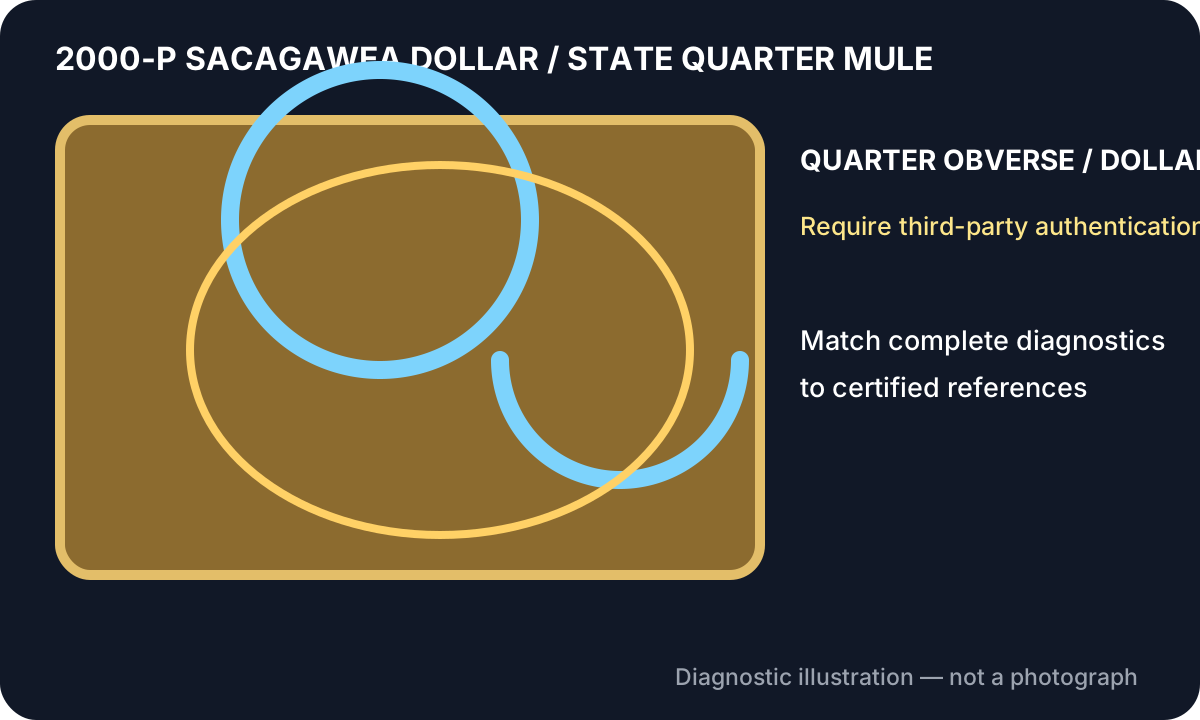
Diagnostic illustration — not a photograph.
Primary Diagnostic
The impossible die pairing is visible without magnification: Washington’s quarter obverse faces the Sacagawea eagle reverse. Correct diameter, weight, edge, surfaces, and known die markers must then be authenticated.
What It Is Not
A novelty two-headed assembly, plated quarter, altered magician’s coin, or joined pair is not a mint mule. A seam, wrong weight, or disturbed edge is disqualifying evidence.
Authentication Caution
Use stable magnification and several lighting angles. Match the complete diagnostic relationship to certified examples, do not clean or alter the coin, and obtain professional authentication before paying a substantial premium.
Image Credit
No exact forensic photograph with sufficiently clear reusable licensing was approved. CoinHunt created this original vector marker map from the cited facts. It explains marker relationships and does not represent grade, color, surface texture, or die stage.
Looking to buy or check current prices for this coin?Search it on CoinHunt →
Revision history
- : Integrated researched diagnostic illustrations, licensing metadata, attribution boundaries, and citations from duplicate variety pages. — Bradley Jones