50 State Quarter
How to Find a 2004-D Wisconsin Extra Leaf Quarter (High or Low)
The 2004-D Wisconsin Extra Leaf quarter is the one entry in this guide that deserves to be called a genuinely significant variety. NGC’s current VarietyPlus overview identifies only two significant recognized varieties across the entire 1999–2008 50 State Quarters Program, and both come from this single issue: the Extra Leaf High and Extra Leaf Low. A small number of Denver-struck Wisconsin quarters show an extra leaf on the ear of corn on the reverse — a design element that doesn’t belong there at all.
CoinHunt helps you search inventory from multiple coin dealers in one place, compare available examples, and create a wishlist alert when the right coin is not currently listed.
Design and history
The 2004 Wisconsin quarter centers on a cow, a round of cheese, and an ear of corn. It belongs to the U.S. Mint’s 50 State Quarters Program, which released five state reverses per year in constitutional-ratification or admission order. The common obverse is the modified John Flanagan portrait of George Washington, adapted by William Cousins so the statutory inscriptions could move to the front and leave the reverse open for each state’s story. The intended imagery is documented by the U.S. Mint’s program record.
On a normal Wisconsin reverse, the corn’s husk leaves at the lower left end without any extra curved projection. On the small number of affected 2004-D coins, an additional leaf-like element appears jutting from that area, cataloged in two distinct forms:
- Extra Leaf High (FS-5901): the extra leaf points upward, toward the ear of corn.
- Extra Leaf Low (FS-5902): the extra leaf points downward, away from the corn, and is the more common of the two varieties.
Errors and varieties to know
This is the key variety in the entire 50 State Quarters series, so it’s worth being precise about it. The 2004-D Extra Leaf High shows a distinct raised leaf rising steeply beside the ear; the Extra Leaf Low shows a lower, more horizontal raised leaf. NGC recognizes both and illustrates all three configurations — High, Low, and normal — in its dedicated coverage of the variety.
How the extra leaf got there is still debated. One theory holds that a stray piece of metal became lodged in the die and was gradually pounded into a permanent gouge, into which coin metal flowed during striking. Others in the numismatic community have suggested the distinct, consistent shape of the leaves looks more deliberate than accidental, though no conclusive explanation has ever been confirmed publicly. The Mint has acknowledged it as a die error without detailing exactly how it happened, which has only added to the coin’s popularity.
Confirm the D mint mark, inspect the lower-left side of the corn under magnification, and compare the entire shape rather than trusting a seller’s arrow. Scratches, glue, plating blisters, and lighting reflections do not reproduce the smooth, raised contour of the attributed varieties. NGC’s separate State Quarter error gallery documents genuine manufacturing errors on other issues, but the Wisconsin Extra Leaf is a true die variety — it repeats on every coin struck from the affected die — not a one-off mint error or damage.
How to examine a 2004-D Wisconsin quarter
Check the corn on the reverse
Look at the lower-left side of the ear of corn, below and to the left of the normal leaves. On a genuine Extra Leaf example, an additional leaf-like element is clearly visible extending from that area, distinct from the coin’s regular design.
Determine High Leaf versus Low Leaf
If the extra leaf angles upward, toward the corn, it’s the scarcer High Leaf variety. If it angles downward, away from the corn, it’s the more common Low Leaf variety. Compare against certified reference photographs, since the distinction matters for both attribution and value.
Confirm the mint mark and date
Only 2004-dated Denver (“D”) quarters are known with this variety. A Wisconsin quarter from Philadelphia, or from any other date, is not part of this error.
Buying considerations
Certified versus raw coins
Because the two varieties look similar at a glance and value depends on which one you have, a certified example from PCGS or NGC that explicitly attributes the coin as “Extra Leaf High” (FS-5901) or “Extra Leaf Low” (FS-5902) removes the ambiguity. Verify the certification number on the grading service’s own website before paying a premium.
Understanding grades
Both varieties exist across circulated and Mint State grades, since many entered circulation before being recognized. Compare strike quality, luster, and marks the same way you would for any Washington quarter when comparing higher-grade examples.
Problem coins
Cleaning, scratches, and environmental damage reduce eye appeal and value on any coin, including these. A details-graded example can be a lower-cost way to own the variety, but the stated problem should be reflected in the price.
Suggested search terms and filters
Begin with a broad search: “2004-D Wisconsin Extra Leaf quarter,” “Wisconsin Extra Leaf High,” or “Wisconsin Extra Leaf Low.”
Then narrow by:
- Variety: Extra Leaf High (FS-5901) or Extra Leaf Low (FS-5902)
- Grade: circulated through Mint State
- Certification: PCGS, NGC, or “certified Wisconsin Extra Leaf”
Availability and pricing notes
The Extra Leaf High variety is scarcer and generally commands higher prices than the Extra Leaf Low, with top certified High Leaf examples having sold at auction for well over $1,000 in Mint State. Lower Leaf examples in typical Mint State grades have traded closer to the low hundreds of dollars. Listings and asking prices don’t necessarily represent completed-sale values, so compare the specific variety, grade, and certification carefully before buying.
CoinHunt does not guarantee that every listing is authentic, accurately graded, or fairly priced. Authentication, grading, pricing, return policies, and fulfillment remain the responsibility of the dealer or marketplace offering the coin.
How the CoinHunt wishlist alert works
- Search for the coin. Enter “2004-D Wisconsin Extra Leaf quarter” to search participating dealer inventory.
- Review the available matches. Compare listings by variety, grade, certification, and asking price.
- Add the search to your wishlist. If the right example isn’t available, save it as a wishlist item.
- Get notified about new matches. CoinHunt sends an alert when new dealer inventory matches your wishlist.
- Evaluate the coin before buying. Verify certification and photographs, and review the seller’s terms.
Frequently asked questions
What’s the difference between Extra Leaf High and Extra Leaf Low?
The extra leaf on the ear of corn points upward, toward the corn, on the High variety, and downward, away from the corn, on the Low variety. The High variety is scarcer.
How did the extra leaf get there?
The exact cause is debated. Leading theories point to a piece of metal debris that became gouged into the die during production, though some collectors believe the distinct shape looks more deliberate. The Mint has confirmed it as a die error without a full public explanation.
Is this the only major state quarter variety?
Yes. NGC’s current VarietyPlus overview identifies the 2004-D Wisconsin Extra Leaf High and Extra Leaf Low as the only two significant varieties it recognizes across the entire 1999–2008 50 State Quarters Program. Other issues in the series may carry minor, specialist-cataloged doubled dies or die states, but none carry the same NGC-recognized status.
Which variety is more valuable?
The Extra Leaf High is generally scarcer and more valuable than the Extra Leaf Low, though both carry real premiums over an ordinary Wisconsin quarter.
What if no suitable coin is currently available?
Add “2004-D Wisconsin Extra Leaf quarter” to your wishlist below. You’ll be notified when newly detected dealer inventory matches your search.
Illustrated diagnostic upgrades
The following marker cards consolidate CoinHunt’s researched variety diagnostics into this canonical guide. Each original vector is a diagnostic illustration, not a photograph, and its licensing record remains with the image asset.
2004-D Wisconsin Quarter Extra Leaf High
Documented Fact The Extra Leaf High is one of two major 2004-D Wisconsin reverse varieties. It has a raised curved feature on the left side of the corn ear that is absent from the normal reverse and sits higher than the Extra Leaf Low feature. [1] [2]
Quick Hunt
- Confirm the obverse carries a D mintmark.
- Turn to the reverse and locate the corn ear between the cow and cheese wheel.
- Inspect the lower-left side of the corn husk for an extra raised curve.
- Confirm that the curve rises toward the corn ear; the Extra Leaf Low arcs downward and remains lower.
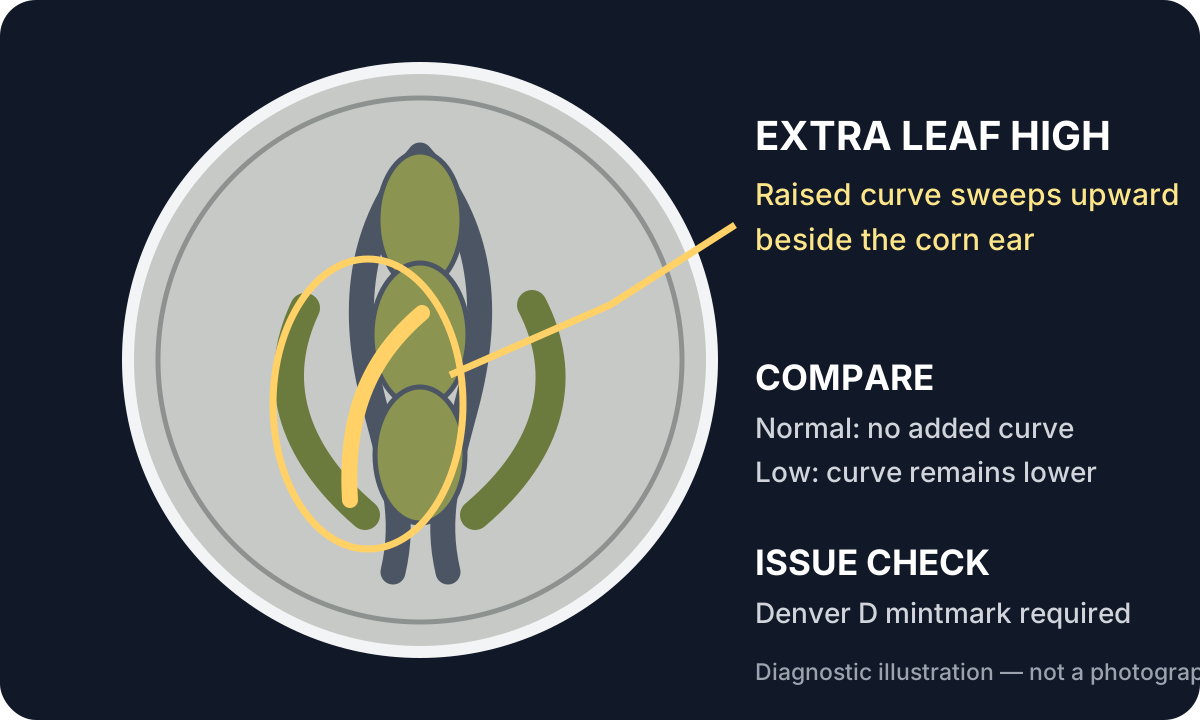
Diagnostic illustration — not a photograph.
Primary Marker — High Curved Feature
The identifying feature begins beside the lower-left husk and sweeps upward into the open field toward the corn. It is raised because metal flowed into a recessed mark in the working die. Attribute the complete placement and curve—not merely any random raised line near the plant.
High vs. Low
The High variety’s added curve terminates farther up beside the corn ear. The Low variety’s feature bows downward near the cheese wheel. A normal Wisconsin reverse has neither added curve. Compare the candidate’s position against all three configurations before assigning the variety.
What It Is Not
- A normal husk fold: part of the intended design and present on ordinary Wisconsin quarters.
- A die crack: usually a thin, irregular raised line that follows a different path.
- A scratch: incuse or displaced post-mint metal rather than a stable raised die feature.
- Extra Leaf Low: a separate recognized reverse with the added feature in a lower position.
Authentication Caution
Do not clean the coin. CoinHunt’s diagram is for screening; valuable examples should be compared with certified references and submitted to a reputable authentication service.
Image Credit
No exact forensic photograph with sufficiently clear reusable licensing was approved. CoinHunt created this original vector marker map from the cited attribution facts. It does not represent grade, color, surface texture, or die stage.
2004-D Wisconsin Quarter Extra Leaf Low
Documented Fact The Extra Leaf Low is the lower-positioned of the two major 2004-D Wisconsin reverse varieties. A raised curved feature appears at the lower-left of the corn husk, close to the cheese wheel, where no such feature exists on a normal reverse. [3]
Quick Hunt
- Confirm the obverse has a D mintmark.
- Find the corn ear and cheese wheel on the reverse.
- Inspect the bottom-left of the corn husk for a raised curve that bows downward.
- Compare its height: the Extra Leaf High sweeps upward alongside the corn instead.
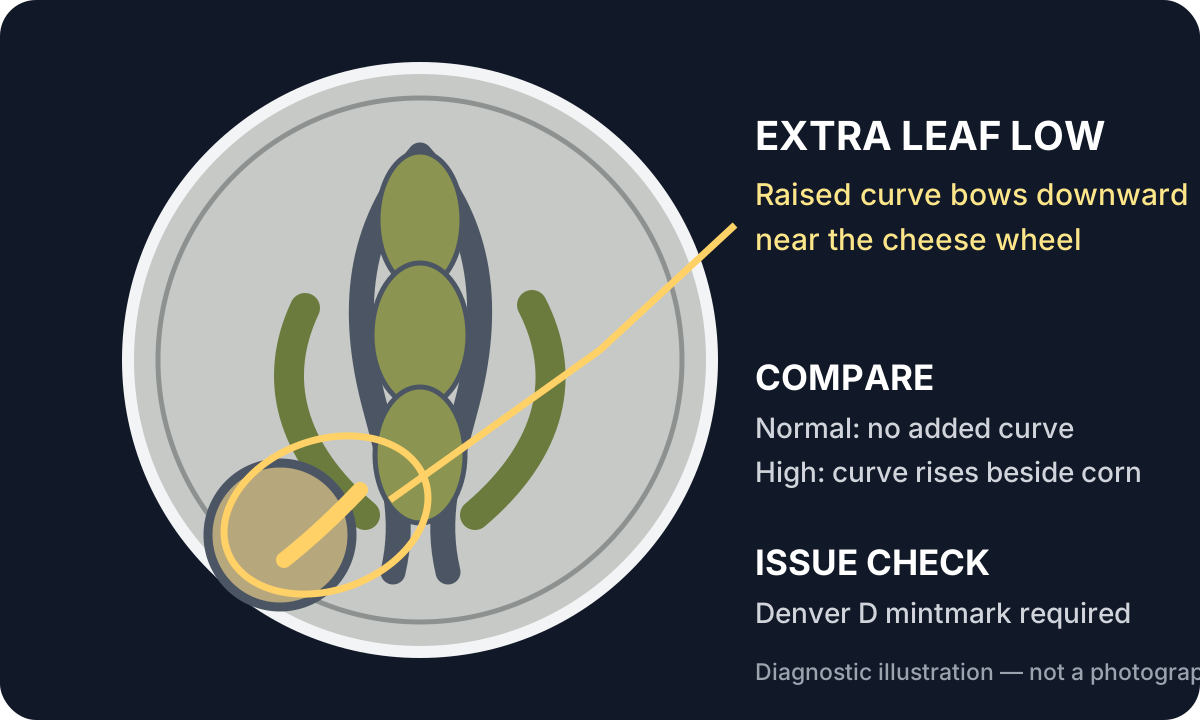
Diagnostic illustration — not a photograph.
Primary Marker — Low Curved Feature
The Low variety has an added raised arc that extends downward from the lower-left husk area toward the cheese wheel. Its low placement and continuous curved shape are more important than a vague resemblance to a leaf.
Low vs. High
The Low feature occupies the space near the base of the plant and cheese wheel. The High feature climbs farther up alongside the corn ear. The normal reverse has neither. Check the whole curve because circulation damage can mimic only part of its outline.
What It Is Not
- Normal design detail: intended husk folds repeat on ordinary examples; the added low arc does not.
- Contact mark or scratch: usually cuts into or displaces metal instead of forming a raised die feature.
- Die crack: commonly narrower and irregular, without the recognized curved placement.
- Extra Leaf High: a separate die with its added feature in a higher position.
Authentication Caution
Do not clean the coin. Use this map to screen candidates, then compare the exact position with certified examples. Seek professional authentication before representing a valuable coin as the Extra Leaf Low variety.
Image Credit
No exact forensic photograph with sufficiently clear reusable licensing was approved. CoinHunt created this original vector marker map from the cited attribution facts. It does not represent grade, color, surface texture, or die stage.
Looking to buy or check current prices for this coin?Search it on CoinHunt →
Revision history
- : Integrated researched diagnostic illustrations, licensing metadata, attribution boundaries, and citations from duplicate variety pages. — Bradley Jones