50 State Quarter
How to Find a 2005 Minnesota Quarter Extra Tree Variety
The 2005 Minnesota “Extra Tree” quarter is a doubled die reverse variety that adds a ghostly extra spruce tree to the reverse design, which depicts the state outline, two children ice fishing, and a line of spruce trees. Minnesota is the main doubled-die hunting ground in the 50 State Quarters series after Wisconsin: more than four dozen different doubled dies showing some version of an extra tree are known from this issue, but one — catalogued by PCGS as FS-801, Doubled Tree DDR-001 — is by far the most pronounced and sought-after.
CoinHunt helps you search inventory from multiple coin dealers in one place, compare available examples, and create a wishlist alert when the right coin is not currently listed.
Design and history
The 2005 Minnesota quarter centers on a lake scene with a loon, anglers, trees, and the state outline. It belongs to the U.S. Mint’s 50 State Quarters Program, which released five state reverses per year in constitutional-ratification or admission order. The common obverse is the modified John Flanagan portrait of George Washington, adapted by William Cousins so the statutory inscriptions could move to the front and leave the reverse open for each state’s story. The intended imagery is documented by the U.S. Mint’s program record.
The composition rewards close looking. Study the trees beside the outline, the loon, the boat, and the shoreline — these are the fixed landmarks needed to compare a suspected variety against a normal coin. Preserve original surfaces: never polish a quarter to make a suspected feature easier to see. Cleaning creates hairlines and may destroy both collector value and diagnostic evidence.
What makes the Minnesota Extra Tree quarter important to collectors?
A doubled die occurs when a working die receives more than one misaligned impression from the hub during manufacture, causing design elements to appear doubled on every coin struck from that die. On the Minnesota quarter’s reverse, the doubling shows up as extra, ghost-like spruce boughs appearing near the fourth tree in the row of trees at the right side of the design, close to the center of the coin.
According to PCGS, dozens of different, more subtle doubled-tree varieties exist from this issue, but the FS-801 DDR-001 variety shows the doubling most clearly and is the one collectors specifically seek out. “Extra tree” is therefore a family nickname, not one universal variety — the location, direction, strength, and accompanying die markers must all agree with a published attribution before you rely on it. Ordinary design overlap, die deterioration, and machine doubling can all create misleading shelf-like lines that are not the same as this doubled die.
Prices have settled down somewhat from an initial wave of high interest, as more examples were identified and certified over time, but well-struck, clearly doubled examples in high grades remain desirable. NGC’s VarietyPlus overview notes that across the entire 50 State Quarters series, only the 2004-D Wisconsin Extra Leaf High and Extra Leaf Low carry that level of formal recognition — the Minnesota Extra Tree family is a well-documented PCGS attribution rather than an NGC-listed major variety, which is worth keeping in mind when comparing how sellers describe it.
How to identify a Minnesota Extra Tree quarter
Locate the fourth spruce tree
On the reverse, find the row of spruce trees along the Minnesota state outline. The doubling appears as extra, ghostly boughs to the right of the fourth tree in that row, roughly in the center of the coin.
Look for three extra “ghost” boughs
On the strongest FS-801 examples, three separate ghost-like spruce boughs are visible extending from that fourth tree, distinct enough to look like part of a fifth tree rather than a blurry smudge. Weaker doubled-tree varieties show less distinct doubling and are not the same as the FS-801 attribution.
Confirm the mint and date
The variety is known from both Philadelphia (“P”) and Denver (“D”) 2005 Minnesota quarters. Compare a candidate coin against certified reference photographs of the specific FS-801 DDR-001 attribution before assuming you have the most desirable version of this variety.
Buying considerations
Certified versus raw coins
Because dozens of more subtle doubled-tree varieties exist alongside the desirable FS-801, a certified example from PCGS that specifically attributes the coin as “FS-801 Doubled Tree DDR-001” is the most reliable way to know exactly what you’re buying. Verify the certification number on PCGS’s own website before paying a premium.
Understanding grades
Value rises with grade. Typical certified examples have traded around $40, with the finest certified examples reaching several hundred dollars; MS65 examples have traded in the range of $150 to $200, with MS66 and MS67 examples in strongest demand from serious collectors.
Problem coins
Cleaning, scratches, and environmental damage reduce eye appeal and value on any modern clad quarter, including this one. A details-graded example can be a lower-cost way to own the variety, but the stated problem should be reflected in the price.
Suggested search terms and filters
Begin with a broad search: “2005 Minnesota Extra Tree quarter,” “Minnesota doubled tree quarter,” or “FS-801 Minnesota quarter.”
Then narrow by:
- Mint: Philadelphia (“P”) or Denver (“D”)
- Grade: circulated through MS67 and above
- Certification: PCGS, or “certified FS-801 DDR-001”
Availability and pricing notes
As more examples have been identified and certified over the years, values have moderated from the coin’s early period of high demand. Listings and asking prices don’t necessarily represent completed-sale values, so compare the specific attribution, grade, and certification carefully before buying.
CoinHunt does not guarantee that every listing is authentic, accurately graded, or fairly priced. Authentication, grading, pricing, return policies, and fulfillment remain the responsibility of the dealer or marketplace offering the coin.
How the CoinHunt wishlist alert works
- Search for the coin. Enter “2005 Minnesota Extra Tree quarter” to search participating dealer inventory.
- Review the available matches. Compare listings by mint, grade, certification, and asking price.
- Add the search to your wishlist. If the right example isn’t available, save it as a wishlist item.
- Get notified about new matches. CoinHunt sends an alert when new dealer inventory matches your wishlist.
- Evaluate the coin before buying. Verify certification and photographs, and review the seller’s terms.
Frequently asked questions
What is the Extra Tree variety?
It’s a doubled die reverse error that adds ghost-like extra spruce boughs near the fourth tree in the row of trees on the Minnesota quarter’s reverse. The strongest, most desirable version is catalogued by PCGS as FS-801, Doubled Tree DDR-001.
Are there other doubled-tree varieties besides FS-801?
Yes — more than four dozen different doubled dies with some version of extra tree doubling are known, but they vary widely in how clear the doubling appears, and FS-801 is the one collectors specifically seek.
Is this variety from Philadelphia or Denver?
Both. The Extra Tree variety is known from both 2005-P and 2005-D Minnesota quarters.
Why have prices come down from early reports?
As more examples were identified and certified, supply increased relative to the initial demand, which brought prices down from the highs seen when the variety was newly discovered.
What if no suitable coin is currently available?
Add “2005 Minnesota Extra Tree quarter” to your wishlist below. You’ll be notified when newly detected dealer inventory matches your search.
Illustrated diagnostic upgrades
The following marker cards consolidate CoinHunt’s researched variety diagnostics into this canonical guide. Each original vector is a diagnostic illustration, not a photograph, and its licensing record remains with the image asset.
2005-P Minnesota Extra Tree FS-801
Documented Fact PCGS identifies FS-801 as the 2005-P Minnesota Doubled Tree DDR-001, the most pronounced of many Minnesota extra-tree doubled dies. [1] [2]
Quick Hunt
- Confirm the Philadelphia P mintmark and Minnesota reverse.
- Inspect the tree line immediately to the right of the state outline.
- Find the specific extra spruce image assigned to DDR-001.
- Compare its position, height, and branch silhouette with certified FS-801 references.
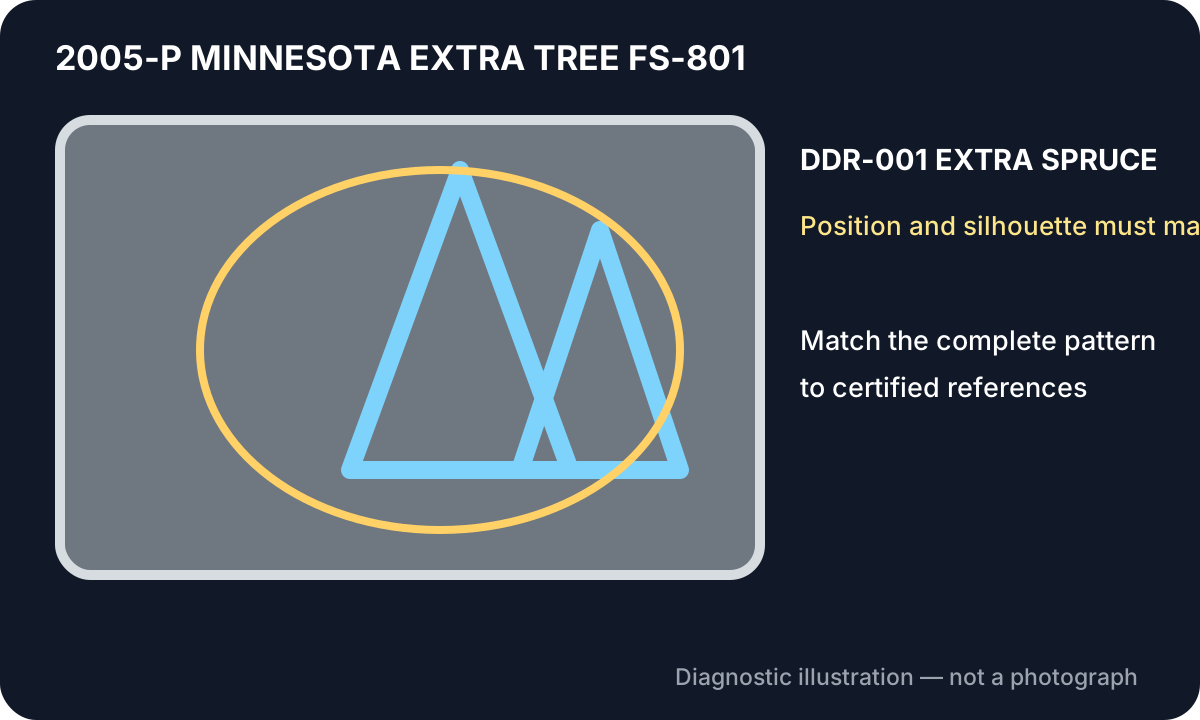
Diagnostic illustration — not a photograph.
Primary Diagnostic
Many Minnesota quarters show other doubled-tree dies. An apparent extra trunk is not enough: FS-801 requires the DDR-001 placement and shape.
What It Is Not
Other Minnesota extra-tree DDR numbers, die chips, scratches, and glare are separate. Do not use FS-801 as a generic label for every added tree.
Authentication Caution
Use stable magnification and several lighting angles. Match the complete marker relationship to certified examples, do not clean the coin, and obtain professional attribution before paying a substantial premium.
Image Credit
No exact forensic photograph with sufficiently clear reusable licensing was approved. CoinHunt created this original vector marker map from the cited facts. It explains marker relationships and does not represent grade, color, surface texture, or die stage.
Looking to buy or check current prices for this coin?Search it on CoinHunt →
Revision history
- : Integrated researched diagnostic illustrations, licensing metadata, attribution boundaries, and citations from duplicate variety pages. — Bradley Jones