Presidential Dollar
2007 George Washington Presidential Dollar Missing Edge Lettering: Errors and Value Guide
The 2007 George Washington Presidential dollar missing edge lettering error is the most widely certified modern U.S. Mint error. Presidential dollars carry their date, mint mark, E PLURIBUS UNUM and, on this 2007 issue, IN GOD WE TRUST incused into the edge rather than on the coin’s face, applied in a separate step from the main strike — and on an estimated 250,000 examples from this first release, that step never happened, leaving a completely smooth, blank edge.
GetCoinHunt helps you search inventory from multiple coin dealers in one place, compare available examples, and create a wishlist alert when the right coin is not currently listed.
Design and history
The Presidential $1 Coin Program began in February 2007 with the George Washington dollar, honoring the 1st president — commander of the Continental Army and the president whose precedents shaped the office. It was the first U.S. circulating coin to use edge-incused lettering for its date and mottos instead of engraving them on the obverse or reverse face. The obverse uses a dedicated presidential portrait with the president’s name, ordinal number and years in office; Don Everhart’s Statue of Liberty reverse is shared across the entire program, making the changing portrait — not a changing reverse — the quickest way to identify each issue.
The coin is a manganese-brass-clad dollar with a copper core, 26.5 mm in diameter and 8.1 grams standard weight. Its golden color is not solid gold and can darken unevenly in circulation. For the 2007 and 2008 issues, IN GOD WE TRUST was part of the edge inscription alongside the date, mintmark and E PLURIBUS UNUM; beginning in 2009 the motto moved to the obverse. See the U.S. Mint Presidential $1 Coin Program and the NGC Presidential Dollars overview for the program’s full release history.
Because the edge lettering was applied in a separate operation from the main strike, some coins were ejected from the press, or otherwise bypassed that step, before the edge collar added the lettering — leaving the coin with a plain, smooth edge and no date, mint mark, or mottos anywhere on it.
Errors and varieties to know
According to PCGS, error coins with missing edge lettering started turning up within weeks of the Washington dollar’s February 15, 2007 release, with a large concentration reported from banks near Jacksonville, Florida. PCGS estimates roughly 250,000 examples were struck without edge lettering, and more than 50,000 have since been certified by PCGS and NGC combined — making it, by certified population, the most widely graded modern error coin in U.S. history. NGC documents missing-edge-lettering examples for each of the first 15 Presidential dollar designs, Washington through Buchanan; see the NGC: Collecting Missing Edge Lettering Presidential Dollars article and the PCGS Presidential Dollars CoinFacts category page.
A normal 2007 edge carries the date, mintmark, E PLURIBUS UNUM and IN GOD WE TRUST. Edge lettering was applied after striking, so it can be oriented either way relative to the portrait — “Position A,” “Position B,” upright, upside down and so-called inverted orientation are not errors by themselves. Genuine missing lettering leaves an otherwise natural, unaltered edge; genuine doubled lettering (also documented on some 2007 Presidential dollars) shows two mechanically applied inscription passes instead of a blank one. A smooth edge with filing, grinding or jewelry-mounting evidence is post-mint alteration, not a Mint error.
Some examples show weak or partial edge lettering rather than a completely blank edge; PCGS catalogues these separately as “weak” or “partial” edge lettering errors, distinct from the fully blank “missing edge lettering” variety. Compare carefully, since the fully blank version is the one most commonly sought under this name.
How to identify a missing edge lettering dollar
Check the edge
Run your finger or eye around the entire edge of the coin. A normal 2007 Washington dollar has incused lettering reading the date, mint mark, E PLURIBUS UNUM and IN GOD WE TRUST. On the error coin, the edge is completely smooth, with no lettering anywhere around it.
Confirm it’s a genuine 2007 Washington dollar
The obverse and reverse design — Washington’s portrait and the Statue of Liberty reverse used across the program — should otherwise look entirely normal. The error is specific to the edge; there should be no other design differences.
Rule out post-mint alteration
Look closely for seams, filing marks, flattened reeding-like tool marks, or jewelry-mounting evidence before accepting a smooth edge as a genuine error. A ground or filed edge can visually mimic a missing-lettering coin but typically shows tooling marks under magnification that a genuine Mint-made blank edge does not.
Buying considerations
Certified versus raw coins
Because the error is common enough that tens of thousands have been certified, and because grade drives most of the price difference, a certified example from PCGS or NGC is worth it mainly for higher-grade coins where the assigned grade matters most to value.
Understanding grades
This is a case where grade matters enormously. According to PCGS, common Mint State grades (MS64–MS65) have sold for roughly $20 to $25, while the finest known examples command dramatically more — PCGS has valued an MS68 example at around $4,250, with only a handful of coins known at that top grade.
Problem coins
Cleaning, scratches, and heavy circulation wear reduce both eye appeal and value, the same as with any coin. Because the appeal of this error is largely about a smooth edge in a high grade, condition matters more here than with many varieties — and because a filed or ground edge can imitate the error, ask for edge photographs from multiple angles and rely on certification for any coin priced as a genuine missing-edge example.
Suggested search terms and filters
Begin with a broad search: “2007 Washington dollar missing edge lettering,” “2007 Presidential dollar smooth edge,” or “2007 Godless dollar error.”
Then narrow by:
- Grade: MS64 through MS68 and above
- Certification: PCGS, NGC, or “certified missing edge lettering”
Availability and pricing notes
Because so many examples exist and have been certified, this is one of the more accessible modern errors for collectors on a modest budget, with prices rising sharply only in the highest certified grades. Listings and asking prices don’t necessarily represent completed-sale values, so compare grade and certification carefully before buying.
GetCoinHunt does not guarantee that every listing is authentic, accurately graded, or fairly priced. Authentication, grading, pricing, return policies, and fulfillment remain the responsibility of the dealer or marketplace offering the coin.
How the GetCoinHunt wishlist alert works
- Search for the coin. Enter “2007 Presidential dollar missing edge lettering” to search participating dealer inventory.
- Review the available matches. Compare listings by grade, certification, and asking price.
- Add the search to your wishlist. If the right example isn’t available, save it as a wishlist item.
- Get notified about new matches. GetCoinHunt sends an alert when new dealer inventory matches your wishlist.
- Evaluate the coin before buying. Verify certification and photographs, and review the seller’s terms.
Frequently asked questions
Why does this error exist?
Presidential dollars have their date, mint mark, and mottos applied to the edge in a separate step from the main strike. On an estimated 250,000 examples from the 2007 Washington dollar’s release, that edge-lettering step didn’t happen, leaving a completely smooth edge.
How rare is this error?
It’s common relative to most collectible errors — PCGS estimates around 250,000 were struck, and more than 50,000 have been certified, making it the most widely graded modern U.S. error coin. Value depends heavily on grade rather than scarcity.
What’s the difference between “missing” and “weak” edge lettering?
Missing edge lettering means the edge is completely blank. Weak or partial edge lettering means some lettering is present but faint or incomplete — PCGS catalogues these as separate, related varieties.
Is this the same as the “Godless dollar” some people mention?
The nickname is sometimes used loosely for edge errors on this series, but it most often refers specifically to coins missing IN GOD WE TRUST. Since the full missing-edge-lettering error removes every edge inscription, including that motto, it’s often the coin people mean by that nickname.
What if no suitable coin is currently available?
Add “2007 Presidential dollar missing edge lettering” to your wishlist below. You’ll be notified when newly detected dealer inventory matches your search.
Illustrated diagnostic upgrades
The following marker cards consolidate CoinHunt’s researched variety diagnostics into this canonical guide. Each original vector is a diagnostic illustration, not a photograph, and its licensing record remains with the image asset.
2007 George Washington Presidential Dollar Missing Edge Lettering
Documented Fact The George Washington missing-edge-lettering error escaped the separate edge-incusing step, leaving off the date, mintmark, IN GOD WE TRUST, and E PLURIBUS UNUM. [1] [2]
Quick Hunt
- Confirm the George Washington Presidential dollar design.
- Rotate the entire edge under magnification and verify that it is completely plain.
- Exclude weak, partial, doubled, or damaged edge lettering, which are different conditions or errors.
- Because the mintmark is itself missing with the edge text, rely on certified attribution rather than claiming P from a visible mark.
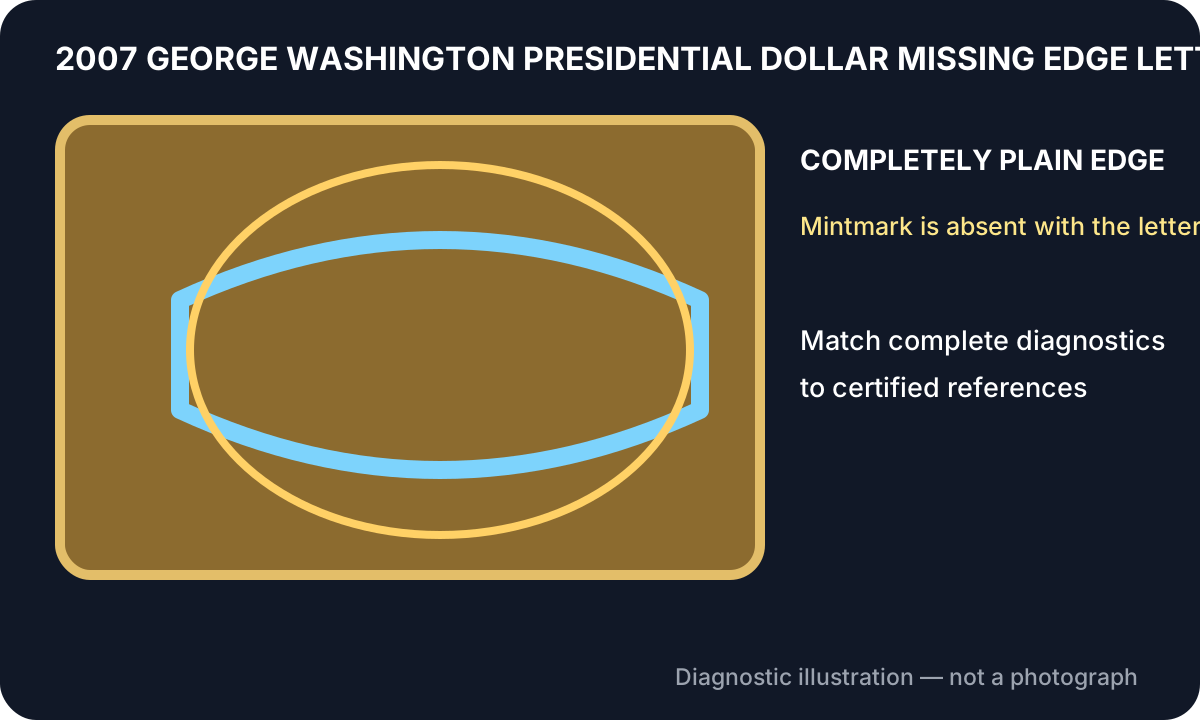
Diagnostic illustration — not a photograph.
Primary Diagnostic
A genuine example lacks the complete edge inscription, not merely one word. The edge should show natural mint surfaces without filing, grinding, or chemical alteration.
What It Is Not
Normal Position A or Position B orientation is not an error. Weak or partial edge lettering, post-mint smoothing, and novelty altered coins are not the fully missing-lettering issue.
Authentication Caution
Use stable magnification and several lighting angles. Match the complete diagnostic relationship to certified examples, do not clean or alter the coin, and obtain professional authentication before paying a substantial premium.
Image Credit
No exact forensic photograph with sufficiently clear reusable licensing was approved. CoinHunt created this original vector marker map from the cited facts. It explains marker relationships and does not represent grade, color, surface texture, or die stage.
Looking to buy or check current prices for this coin?Search it on CoinHunt →
Revision history
- : Integrated researched diagnostic illustrations, licensing metadata, attribution boundaries, and citations from duplicate variety pages. — Bradley Jones