American Women Quarter
2023 Edith Kanakaʻole Quarter Errors, Varieties and Value Guide
The 2023 Edith Kanakaʻole quarter is one of five reverses released in the second year of the U.S. Mint’s American Women Quarters Program, and it is the source of the series’ best-known die clash. GetCoinHunt helps you search inventory from multiple coin dealers in one place, compare available examples, and create a wishlist alert when the right coin is not currently listed.
Design and history
Edith Kanakaʻole was a Native Hawaiian composer, chanter, dancer and teacher whose work preserved and renewed Hawaiian language, stories, hula and ecological knowledge. Her teaching joined cultural practice with close attention to the land. The reverse shows her hair and lei poʻo merging into a Hawaiian landscape, with the phrase E HŌ MAI KA ʻIKE — “granting the wisdom” — connecting chant, hula and the transmission of knowledge. The reverse was designed by Emily Damstra and sculpted by Renata Gordon, per the U.S. Mint’s 2023 design announcement.
Every American Women quarter, including this one, carries Laura Gardin Fraser’s portrait of George Washington on the obverse. Fraser originally created and sculpted that portrait as a candidate for the 1932 Washington quarter; it was recommended at the time but not selected. Its use beginning in 2022 recovered an important work by a prominent American sculptor rather than commissioning a new portrait designed only to look old.
The obverse carries LIBERTY, IN GOD WE TRUST, the date and mintmark. Circulation coins came from Philadelphia and Denver. San Francisco produced collector versions, including clad and 99.9% silver proofs. A mirrored proof found outside its original packaging is not an error, and an S mintmark by itself does not prove rarity. Standard circulating clad quarters weigh 5.67 grams and measure 24.26 mm in diameter.
Errors and varieties to know
This issue is the source of the die clash collectors call “Unicorn George.” During a die clash, the obverse and reverse dies contacted each other without a planchet properly separating them. A lock of hair from the Edith Kanakaʻole reverse impressed the obverse die; subsequent strikes then show a raised, horn-like projection from Washington’s forehead.
Diagnose the effect by position and shape, not nickname alone. The horn must be raised, because it comes from a recessed clash mark in the obverse die, and it should align with the corresponding reverse hair element when the two die faces are mentally overlaid in their opposed orientation. A random incuse scratch, a plating blister, or an irregular raised die chip without that alignment is not the Unicorn George clash. Clash strength can vary as the dies continue working or are polished, so examples range from bold to faint.
Design complexity matters here too. Normal relief lines in Washington’s forehead, the merging hair-and-landscape contours, lei details, diacritics and the small Hawaiian inscription on the reverse can appear doubled when light strikes from the side. If a suspected feature follows the intended artwork, changes when the light moves, or exists only in a blurry photograph, it is not enough for an attribution.
Diagnostic illustration
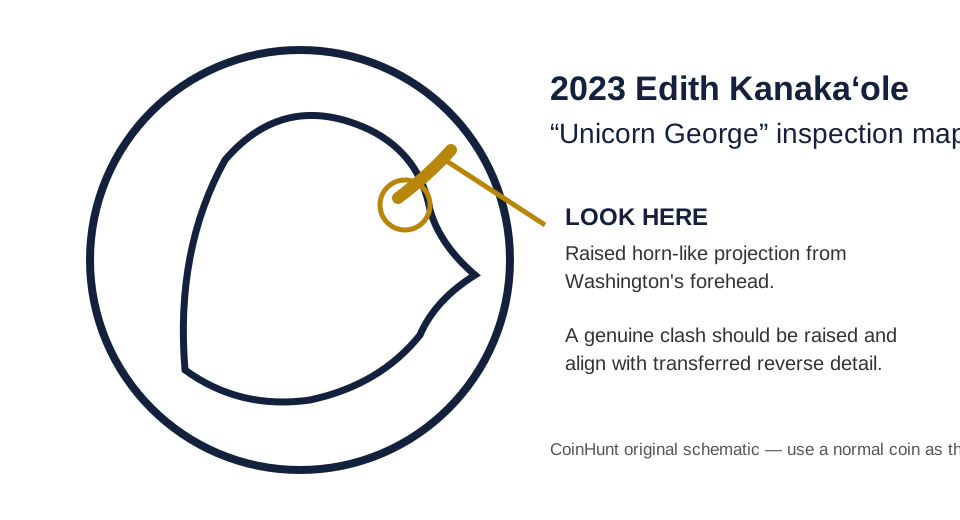
Original CoinHunt diagnostic schematic — not a photograph. The highlighted area locates the raised forehead feature; use a normal coin as the control and verify a suspected clash against attributed examples.
How to examine a 2023 Edith Kanakaʻole quarter
Begin with Washington’s forehead on the obverse, then move to the merging hair-and-landscape contours, lei details, diacritics and the small Hawaiian inscription on the reverse. Use a normal coin as a control and tilt both pieces under a single lamp instead of relying on digital zoom, which can exaggerate pixels, glare and compression halos.
- A genuine die clash mark (like the Unicorn George horn) is raised and aligns with a corresponding recessed element on the opposing die.
- A genuine die chip or die crack is raised because metal flowed into a recess in the die.
- A scratch, gouge or contact mark is normally cut into the coin and may show displaced metal.
- Grease-filled dies cause weak or missing detail without adding raised metal.
- Mechanical doubling is usually flat and shelf-like; a true doubled die shows rounded secondary design and consistent separation in the same places on matching examples.
- A convincing off-center strike omits part of the design and normally leaves a blank crescent; a slightly shifted rim on only one face is more likely a minor misaligned die.
- A genuine clip is missing metal before the strike and should show compatible rim and edge behavior.
- A smooth depression can be a strike-through, while a sharp scrape with exposed fresh metal occurred after striking.
Dryer coins, spooned edges, vise jobs, plated novelty pieces and environmental corrosion are damage or alteration, not Mint errors. Weight is a useful screen, never a verdict — standard clad quarters weigh 5.67 grams, but circulation wear, debris and inexpensive scale error affect readings. Do not clean a candidate; cleaning changes surfaces and can erase evidence needed for authentication. Photograph the whole obverse, reverse and edge before taking close-ups, then verify the mintmark and seek an exact die match from a recognized attribution service or grading company before paying a premium.
Buying considerations
Certified versus raw coins
A certified coin has been authenticated, graded, and sealed in a holder by a third-party grading service such as PCGS or NGC. Given the collector demand around the Unicorn George clash, certification is worthwhile for any coin sold under that attribution — confirm the holder is from a recognized grading service and verify the certification number through that service’s official website before paying a premium.
Understanding grades and condition
Most circulated examples are worth 25 cents. Value beyond face depends on a demonstrable error, exceptional grade, proof status or collector demand — not simply on the honoree or a dramatic online title. A bold Unicorn George clash with clear visual impact generally attracts more interest than a faint one. When comparing listings, look at strike quality on the hair and lei, remaining luster on uncirculated coins, and any marks, scratches or discoloration.
Problem coins
Watch for listings describing cleaned, improperly cleaned, scratched, bent, damaged, corroded, environmental damage, or altered surfaces. Problem coins are sometimes placed in holders with a details grade rather than a standard numerical grade — they can be a less expensive way to own the coin, but you should understand the stated problem and compare the asking price accordingly.
Suggested search terms and filters
Begin with a broad search: “2023 Edith Kanakaʻole quarter,” “2023-P Edith Kanakaʻole quarter,” “2023-D Edith Kanakaʻole quarter,” or “2023-S Edith Kanakaʻole proof quarter.”
Then narrow with terms that reflect your collecting goal:
- By mint mark: P, D, or S (proof, including silver proof)
- By grade: circulated, MS60–MS70, PR60–PR70
- By certification: PCGS, NGC, or “certified Edith Kanakaʻole quarter”
- By feature: “Unicorn George die clash” (described accurately as a die clash, not marketed as a separate Mint design)
Availability and pricing notes
Coin availability can change quickly, and listings or asking prices do not necessarily represent completed-sale values. Compare multiple examples, consider each coin’s grade and surface quality, and check completed auction records for the same mint, error type and grade before purchasing.
GetCoinHunt does not guarantee that every listing is authentic, accurately graded, or fairly priced. Authentication, grading, pricing, return policies, and fulfillment remain the responsibility of the dealer or marketplace offering the coin.
How the GetCoinHunt wishlist alert works
- Search for the coin. Enter “2023 Edith Kanakaʻole Quarter” to search participating dealer inventory.
- Review the available matches. Compare listings by grade, certification, condition, dealer, and asking price.
- Add the search to your wishlist. If the right example is not available, save “2023 Edith Kanakaʻole Quarter” as a wishlist item. Add grade, grading-service, or price preferences when those options are available.
- Get notified about new matches. When new dealer inventory matches your wishlist, GetCoinHunt sends an alert so you can review the listing before it disappears.
- Evaluate the coin before buying. Open the dealer’s listing, verify the certification and photographs, read the complete description, and review the seller’s terms.
Frequently asked questions
What does the 2023 Edith Kanakaʻole quarter depict?
Her hair and lei poʻo merge into a Hawaiian landscape, with the phrase E HŌ MAI KA ʻIKE (“granting the wisdom”). The reverse was designed by Emily Damstra and sculpted by Renata Gordon.
What is the “Unicorn George” variety?
A die clash where a lock of hair from the Kanakaʻole reverse impressed the obverse die, leaving a raised, horn-like projection from Washington’s forehead on later strikes. It is a collectible die-state feature, and genuine examples should show alignment with the corresponding reverse hair element, not just a raised bump.
How do I tell a die variety from a mint error or damage?
A die variety repeats on every coin struck from the same die and shows raised, rounded, repeatable detail. A mint error is an individual manufacturing accident, such as an off-center strike or wrong planchet. Post-mint damage happens after the coin leaves the Mint and is not a genuine feature.
Is a 2023 Edith Kanakaʻole quarter worth much?
Most circulated examples are worth 25 cents. Value concentrates in high-grade uncirculated coins, certified proofs, and coins with a well-formed, certified Unicorn George clash.
What if no suitable coin is currently available?
Add “2023 Edith Kanakaʻole Quarter” to your wishlist below. You’ll be notified when newly detected dealer inventory matches your search.
Looking to buy or check current prices for this coin?Search it on CoinHunt →